This month’s issue of Hispanic Outlook recognizes the plethora of programs offered by colleges, universities and community organizations that are designed to support Hispanic/Latino leadership in a variety of fields. In light of this theme, we offer our readers a look at the latest data on Hispanic/Latino students who have committed themselves to a career that can catalyse change across communities: educational leadership.
Although the number of Hispanic/Latino school principals, superintendents, college presidents and chancellors has certainly increased over time and is quite prominent in some regions, it is still important to ascertain the extent to which they may be under-represented, and the work that can be done to increase their presence in positions of leadership. Educational leadership is naturally attained in many ways that do not necessarily depend on obtaining a degree in this area (such as career advancement, seniority, or gaining recognition in specific areas of expertise required by an institution, for example). Nonetheless, concrete data on degrees granted by level and area of educational administration provides useful insights into an important component of Hispanic/Latino students’ career pipeline.
Overall Landscape of Educational Administration and Supervision (EA&S) Degrees Awarded to Hispanics/Latinos
According to the most recent NCES IPEDS data on the broad Carnegie category “Educational Administration and Supervision” (referred to as EA&S in this article), in the 2024-25 academic year there were a total of 775 mainland U.S. higher education institutions that awarded one or more degrees in this area, at all levels of study. At these institutions:
· Hispanic/Latino students were awarded a total of 4,310 EA&S degrees, while the total number of degrees awarded to students of all ethnicities was 33,831. Thus, EA&S degrees for Hispanic/Latino students represented 13% of all degrees granted in this area.
· Following a pattern that has been found in other areas of study, many more EA&S degrees were granted to Hispanic/Latino women (3,128) than to men (1,182). Indeed, in this field, women earned nearly three-quarters (73%) of all degrees conferred to Hispanics/Latinos.
EA&S Degrees by Level of Studies
The data on EA&S degrees awarded in 2024-25, broken down by level of studies, indicates that:
· The majority (24,270) of all EA&S degrees were awarded at the Master’s level (72% of the total), followed by 8,993 Doctor’s degrees (27% of the total). The number of Bachelor’s degrees awarded in this area was quite small (only 536, 2% of the total), awarded at 19 schools. Associate’s degrees were almost negligeable (32), and they were awarded at only 3 institutions.
· Likewise, most EA&S degrees awarded to Hispanic/Latino students were Master’s degrees (3,267, 76% of all EA&S Hispanic/Latino degrees), followed by 984 Doctor’s degrees (23% of the total). There were 57 EA&S Bachelor’s degrees granted to Hispanics/Latinos, and only 2 Associate’s degrees in this area, accounting for a tiny percentage of all Hispanic/Latino EA&S degrees.
· Hispanic/Latino EA&S degrees represent a relatively small proportion of total degrees granted, at all levels of study. EA&S Master’s degrees awarded to Hispanic/Latino students constitute 13% of all EA&S Master’s degrees, and Hispanic/Latino Doctor’s degrees make up 11% of all Doctor’s degrees in this area. At the Associate’s level, only 6% of all degrees were conferred to Hispanic/Latino students, while at the Bachelor’s level, 11% of total degrees were awarded to Hispanics/Latinos.
EA&S Degrees by Area of Studies
The broad category of Educational Administration and Supervision includes 14 sub-areas, according to the IPEDS classification. These narrower fields of study are summarized in the table below.
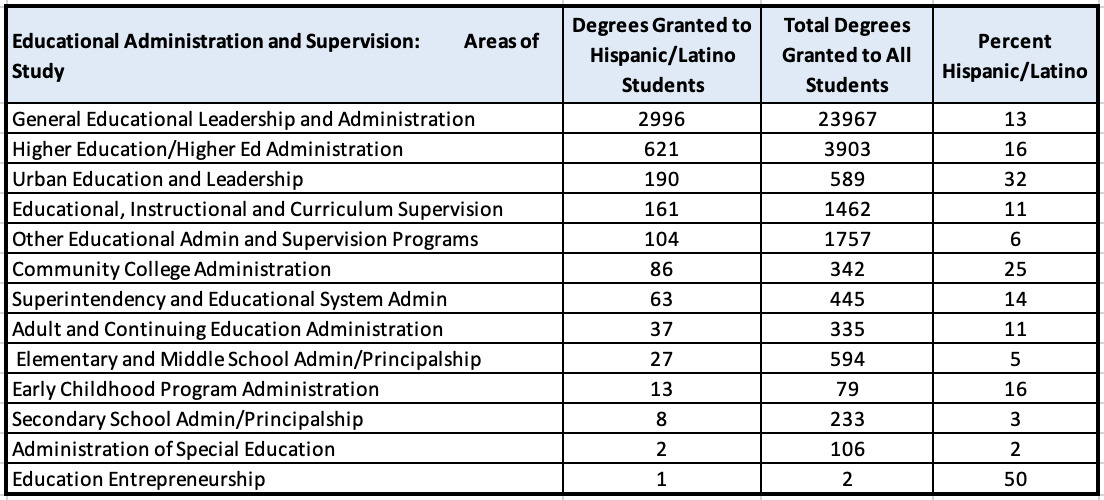
The data on EA&S degrees awarded in 2024-25, broken down by area of studies, indicates that:
· By far the largest number of degrees were granted in the area of General Educational Leadership and Supervision, representing 71% of all EA&S degrees. This was also true for degrees conferred to Hispanic/Latino students.
· Among the remaining areas, the largest number of degrees were conferred in Higher Education/Higher Education Administration, both in general and to Hispanic/Latino students specifically. Indeed, this area represents 12% of all EA&S degrees, and 14% of all Hispanic/Latino EA&S degrees.
· Hispanic/Latino students are most well-represented in the area of Urban Education and Leadership, where nearly one-third (32%) of all degrees were granted to them. This is followed by Community College Administration, where a quarter of all degrees were conferred to Hispanic/Latino students.
Top Schools with Highest Number of Educational Administration and Supervision Degrees Granted to Hispanics/Latinos
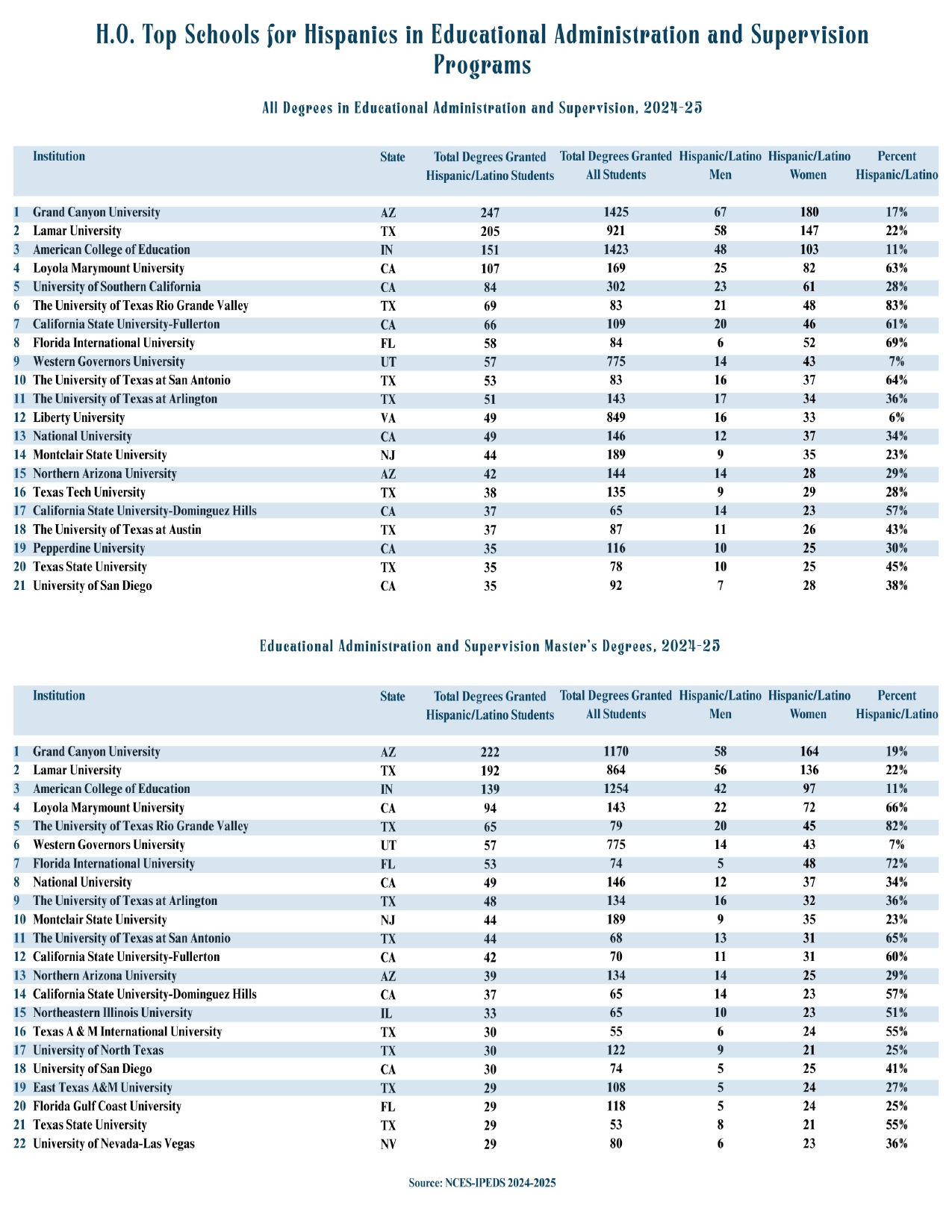
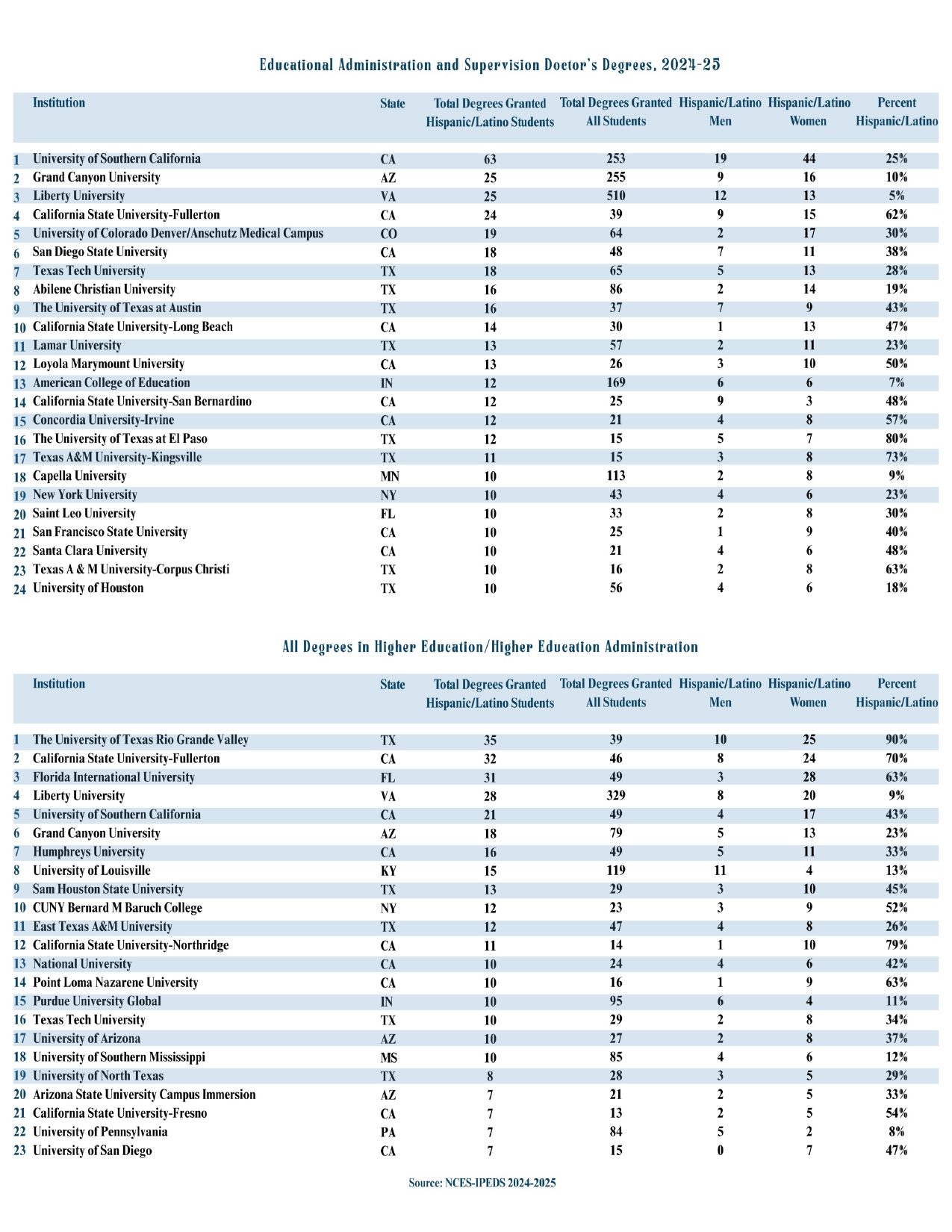
The lists below show the top Hispanic/Latino-serving schools, based on four categories: the number of overall EA&S degrees awarded to Hispanic/Latino students, the number awarded at the Master’s level, at the Doctor’s level, and in the large EA&S sub-area of Higher Education Administration (the largest area, General Educational Leadership and Administration, was not included given that the institutions are nearly identical to those in the list of overall EA&S degrees awarded).
These rankings indicate that:
· The majority of the top 25 Hispanic/Latino EA&S degree-granting schools (first list) are public (60%), although four of the top five are private. The largest number (nine) are located in Texas, followed by California with eight; both of these states together constitute two-thirds (68%) of all top EA&S institutions.
· More than one-third (39%) of all EA&S degrees granted to Hispanic/Latino students are conferred at the top 25 schools, showing a high concentration of Hispanics/Latinos at a small number of institutions offering programs in this area.
· Although there is naturally an overlap between the list of overall top Hispanic/Latino degree-granting schools and those for top Master’s and Doctor’s degree-granting schools, with many institutions present in all three, only Grand Canyon University in Arizona is among the top five across these degree levels. The University of Southern California is among the top five in the sub-area of Higher Education Administration, as well as among the top five Doctor’s degree-granting institutions and overall degree-granting institutions. The University of Texas Rio Grande Valley is also notable for being the top degree-granting institution for Higher Education Administration, as well as the fifth-ranked Master’s degree-granting institution, and sixth-ranked overall degree-granting school.
· Among the top overall Hispanic/Latino degree-granting schools, the University of Texas at El Paso confers the highest proportion of degrees to Hispanic/Latino students (87%), followed by the University of Texas Rio Grande Valley (with 83%). UT Rio Grande Valley also awards the largest proportion of Master’s degrees to Hispanic/Latino students (82%), followed by Florida International University (72%), while UT El Paso awards the largest proportion of Doctor’s degrees to this group (80%).
· Among the top institutions granting Higher Education Administration degrees to Hispanic/Latino students, UT Rio Grande Valley and California State University Fullerton awarded the largest proportion of these degrees to Hispanic/Latino students, representing 90% and 70% of the total, respectively.
In addition to the rankings included below, the data sheds light on other notable points:
· Among the ten institutions that awarded EA&S Bachelor’s degrees to Hispanic/Latino students, those with the largest number were the private Rasmussen University in Minnesota (with 17 degrees) and Ohio State University-Main Campus (with 13 degrees); the two institutions that awarded EA&S Associate’s degrees to Hispanic/Latino students were Lansing Community College and Oakland Community College, both in Michigan (only one degree each).
· The top institutions awarding Urban Education and Leadership degrees to Hispanic/Latino students (the third largest sub-area) were Loyola Marymount University in California and the University of Colorado Denver, with 87 and 19 Hispanic/Latino degrees, respectively.
· The top institutions awarding Community College Administration degrees to Hispanic/Latino students (an area with a high proportion of Hispanics/Latinos) were California State University-Fullerton (13 degrees, representing 65% of total EA&S degrees at that institution) and Northern Arizona University (12 degrees, constituting 29% of the total).