Amid the turbulence of polarized politics, global economic and ecological uncertainties and rapid technological developments, higher education institutions continue to offer students from all walks of life opportunities to grow personally, to achieve social mobility, and to develop the capacity to debate, face and change these conditions. College-age, young Hispanics/Latinos are a rapidly expanding, dynamic segment of the U.S. population, who are already actively shaping national economic, political and social life, and will continue to do so with even more impact. In order to better understand their future trajectory, Hispanic Outlook strives to lay the groundwork by providing concrete data on the current landscape of Hispanics/Latinos in higher education. One of the main components of this task is presenting readers with our annual lists that recognize the specific institutions with the highest Hispanic/Latino enrollments and degrees; these lists also allow us to provide an overview of general trends across these top 100 institutions.
The following pages include lists on enrolment at 2- and 4-year institutions, and degrees granted by level and field of study, drawing on the latest data (for the 2024-25 academic year) from the most reliable and comprehensive source – the federal NCES Integrated Post-Secondary Education Data System (IPEDS).
General Trends
A look at the aggregated data for the top 100 institutions that serve the highest number of Hispanics/Latinos allows us to present some overall patterns in enrolment and degrees granted, and also reveals trends over the past few years. What is the current overall landscape for Hispanic/Latino students, and have there been notable changes when compared with the past few academic years (2022-23 and 2023-24)
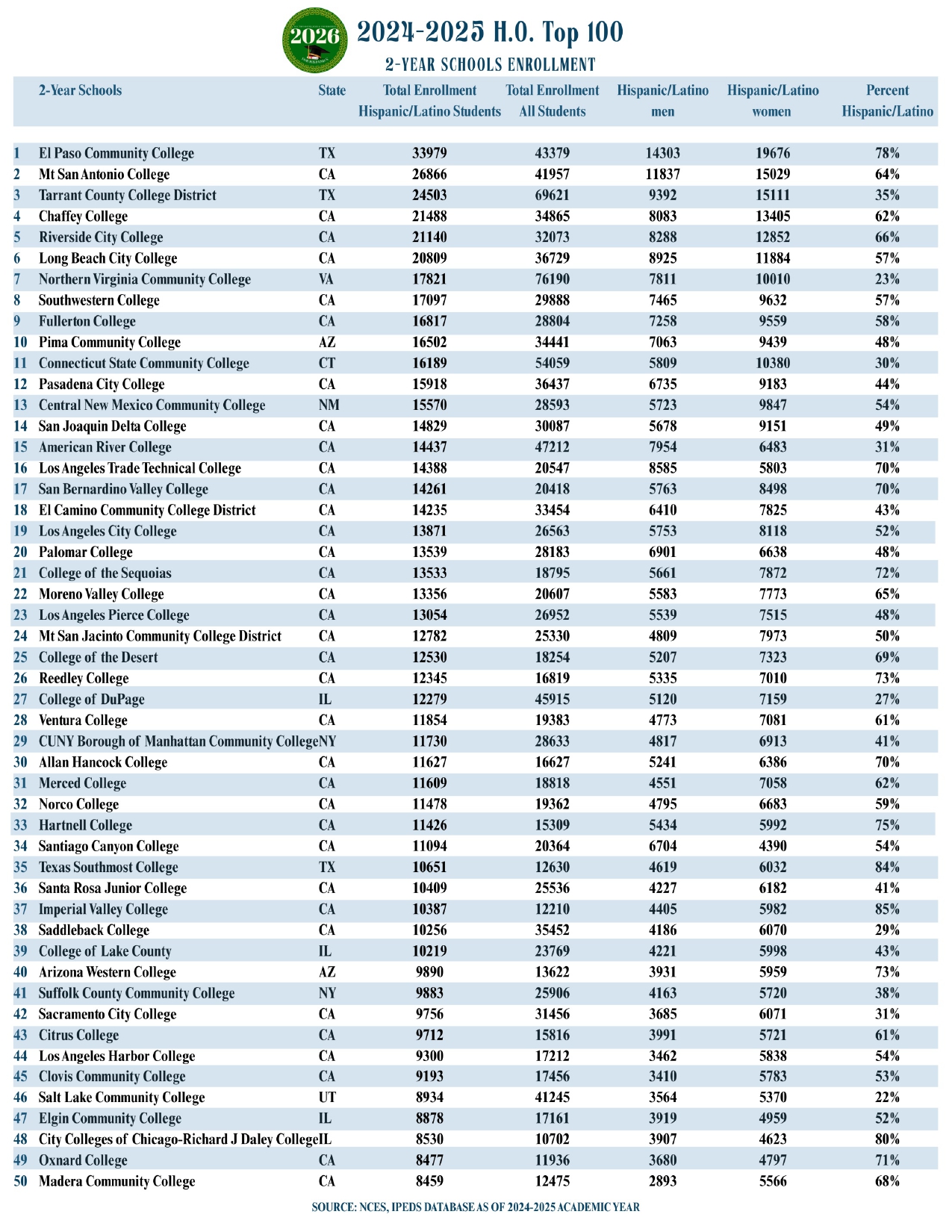
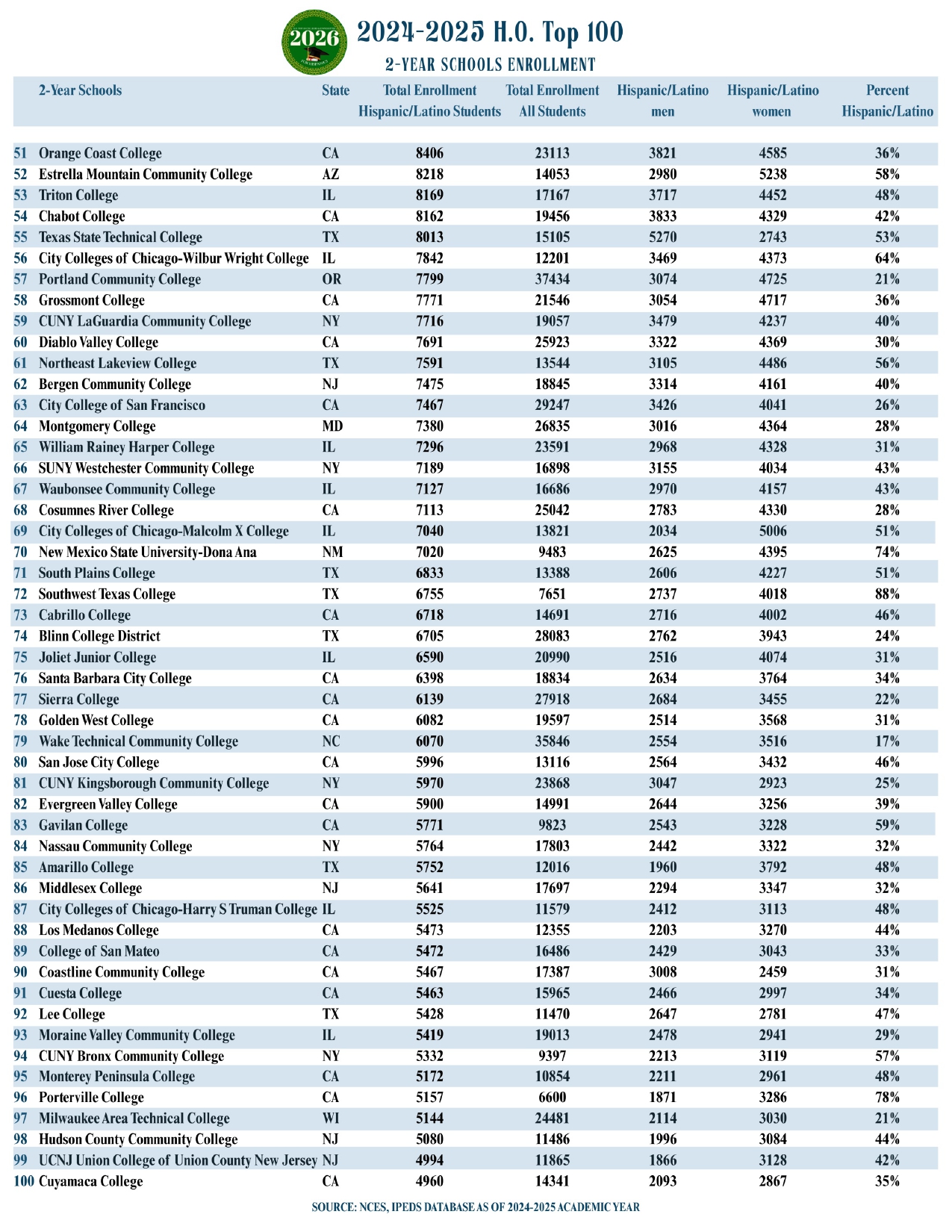
• Between 2023-24 and 2024-25, Hispanic/Latino total enrolment at all top 100 2-year schools decreased slightly (breaking a pattern of continuous growth over the two previous years), while it increased substantially at top 100 4-year schools.
At the top 100 2-year schools, total Hispanic/Latino enrolment grew by 30,755 students between 2021-22 and 2023-24, but dropped by 10,914 students between 2023-24 and 2024-25. In contrast, at top 4-year schools, growth in total Hispanic/Latino enrolment has been accelerating over the past three academic years: there was an increase of 65,673 students between 2021-22 and 2022-23, and a larger increase of 118,814 students between 2022-23 and 2023-24; an additional 140,261 students have enrolled at these 4-year schools between 2023-24 and 2024-25.
• Thus, enrolment at 4-year schools continues to be substantially higher than enrolment at 2-year schools.
In 2024-25, the total number of Hispanic/Latino students enrolled at the top 100 4-year schools was 1,799,560 while the total number enrolled at the top 100 2-year schools was 1,013,545. Thus, nearly 800,000 more Hispanic/Latino students were enrolled at top 100 4-year schools than at top 100 2-year schools.
• The majority of top Hispanic/Latino-enrolling institutions are public.
In 2024-25, as in previous years, all the top 100 2-year institutions in terms of largest Hispanic/Latino enrolment were public. Among the top 100 4-year institutions, 89 were public and only 11 were private (3 of these, for-profit).
• A large proportion of Hispanic/Latino students are still concentrated in a fairly small number of institutions.
In 2024-25, there were 429,514 Hispanic/Latino students enrolled at the top 25 2-year institutions (with more than 12,500 enrolled at each). Thus, enrolment at the top quarter of 2-year institutions represented a very large proportion (42%) of total enrolment at all 100 of these institutions. Likewise, there were 820,899 Hispanic/Latino students enrolled at the top 25 4-year schools (with more than 21,500 enrolled at each), which also represents nearly half (46%) of total enrolment at all 100 of these schools.
• Hispanic/Latino students represent more than half of the total student body at a large number of both 2-year and 4-year top 100 institutions; Hispanic/Latino students also represent more than a quarter of all students at a larger number of 2-year top 100 institutions than 4-year ones.
As in previous years, in 2024-25 Hispanic/Latino students made up the majority of the total student body (50% or more) at a large number of the top 100 2-year institutions (43 of these) and 4-year institutions (37 of these). However, only 7 of the top 100 2-year schools had less than 25% Hispanic/Latino students (the minimum threshold for becoming a Hispanic Serving Institution), while nearly a quarter (24) of top 4-year schools had less than 25% Hispanic/Latino enrolment.
• Overall, there were more Hispanic/Latino women than men enrolled in 2024-25, continuing a notable trend over the past years.
Among Hispanic/Latino students enrolled at all top 100 2-year schools, 58% were women and 42% were men. This means that 153,131 more women than men were enrolled at all of these institutions; indeed, only seven 2-year schools on the list had more Hispanic/Latino men enrolled than women. Likewise, at all top 100 4-year schools Hispanic/Latino women represent 59% of all Hispanic/Latino enrolment; given the larger overall enrolment numbers at these schools, the gap in absolute terms is even greater, with 322,676 more women enrolled than men. Among all top 4-year institutions, only five enrolled more Hispanic/Latino men than women.
• The majority of top Hispanic/Latino-enrolling 2- and 4-year institutions were concentrated in a few states, primarily California and Texas.
Over half (55) of top 2-year schools were in California alone, followed by 12 in Illinois and 10 in Texas; thus, more than three-quarters of these schools were located in only three states. The next largest number were in New York (7) and New Jersey (4); the remaining 12 were spread across nine additional states. Among top 4-year schools, more than half were located in two states: over one-third (37) in California, and another 24 in Texas. The next largest number were in Florida (14) and Arizona (8); thus, the majority (83 of the top 100) were in only four states. The remaining 17 of these top 4-year schools were located in another 14 states.
Graduate degrees for Hispanic/Latino students are still lagging far behind associate degrees and bachelor’s degrees, with around three times less degrees granted at the Masters level than at the other levels.
In the 2024-25 academic year, the total number of associate degrees granted at all 100 listed institutions was 152,835; total bachelor’s degrees granted were 189,248 and total masters degrees were 57,489.
• The total number of associate, bachelor’s and master’s degrees at the top Hispanic/Latino degree-granting institutions increased very modestly over the past academic year, with the largest increase among associate degrees.
Between 2023-24 and 2024-25, the total number of associate degrees granted at all top 100 listed institutions increased by 9,483, while the total number of bachelor’s degrees increased by 7,543, and total master’s degrees grew by 4,042.
As with enrolment, a gap between total degrees granted to Hispanic/Latino women and men is apparent at these top 100 institutions, at all levels.
At the associate level, 62% of all degrees granted to Hispanics/Latinos at the top 100 institutions were awarded to women; this is also the case at the bachelor’s level. The widest gap exists at the master’s level, where women received more than two-thirds (68%) of all degrees granted to Hispanic/Latino students.
Specific Institutions
• In 2024-25, El Paso Community College and Mt. San Antonio College retained their top positions in terms of enrolment of Hispanic/Latino students at 2-year institutions; they were joined by Tarrant County College District in third position.
East Los Angeles College (the top-ranked 2-year school in 2023-24) was no longer on this list, given its’ new classification as a 4-year school. Two-year institutions with the highest percentage of Hispanic/Latino students as a proportion of total students were Southwest Texas College (88%), Imperial Valley College (85%) and Texas Southmost College (84%).
One institution joined the top 20 2-year schools in 2024-25: San Joaquin Delta College (passing from #25 in 2023-24 to #14 in the current list).
• Among 4-year institutions, the top 2 in terms of Hispanic/Latino enrolment have retained their position: Miami Dade College and Dallas College; they were joined by Western Governor’s University in third position.
The 4-year institutions with a student body primarily composed of Hispanic/Latino students (more than 90%) continued to be Laredo College (95%), South Texas College (96%) and the University of Texas Rio Grande Valley (91%).
Two institutions joined the top 20 4-year schools in 2024-25:
East Los Angeles College at #10 (which was previously classified as a 2-year school and appeared in first place on that list in 2023-24), and Arizona State University Digital Immersion (passing from #23 in 2023-24 to #19 in the current list).
• Institutions awarding the largest number of associate degrees to Hispanic/Latino students were Miami Dade College, Lone Star College System and Dallas College, which retained their top positions.
In terms of associate degrees awarded to Hispanics/Latinos as a proportion of all associate degrees granted, the top schools in 2024-25 have remained the same since 2022-23: Laredo College (96%), South Texas College (96%) and Texas Southmost College (91%).
• The largest number of bachelor’s degrees was awarded to Hispanics/Latinos by Florida International University and the University of Texas Rio Grande Valley, which have retained their top positions. They were joined in third place by the University of Central Florida.
The University of Texas Rio Grande Valley and Texas A & M International University again had the largest percentage of these degrees awarded to Hispanic/Latino students (with 94% and 91% of all degrees respectively); they have held this position for at least the past three years.
• With regard to master’s degrees, Hispanics/Latinos received the largest number of these at Western Governors University, Grand Canyon University and Florida International University, as they did in 2023-24.
Miami Regional University, Ana G. Mendez University and the University of Texas Rio Grande Valley had the largest proportion of master’s degrees awarded to Hispanics/Latinos (88%, 77% and 77% of total master’s degrees, respectively).
Download the complete 2026 H.O. Top 100 Colleges and Universities for Hispanics lists