For over two decades, the University of Nevada, Reno’s Latino Research Center (LRC) has served as a bridge between the university and Nevada’s growing Latino community. It was initially founded to address gaps in research, representation, and access, but it has evolved into a statewide resource for research, as the only center of its kind in Nevada. Established in 2004 with legislative support from the United States (U.S.) Department of Education, the late U.S. Senator Harry Reid and Nevada Assemblywoman Sheila Leslie, the LRC was introduced as the Latino Institute for Advocacy in Education, Research and Policy within the College of Liberal Arts. Over the years, its name and institutional home have changed, but its central purpose has remained remarkably consistent – to serve as a nexus between the university and the Latino community and to ensure that research and higher education respond to the realities and aspirations of Nevada’s Latino population. Today, the Latino Research Center operates within the Office of the Provost, and its mission is centered on four interconnected areas: (a) research, (b) faculty collaboration, (c) student achievement, and (d) advocacy and outreach.
Research that Matters to Nevada
Research is at the heart of the Latino Research Center’s work. Rather than viewing the Latino community through a single lens, the LRC examines Latinos’ diverse experiences across four broad areas: education, economy, public health, and civic engagement/immigration. These areas reflect the interconnected nature of community well-being. The emphasis is on knowing that one element influences another, such as educational attainment contributing to the state’s economic opportunity, and social mobility influencing access to health care, while immigration status and civic participation can shape a student’s ability to access and complete an education.
The LRC produces research in various formats, including academic publications, reports, white papers and accessible fact sheets designed to make data useful beyond academic audiences. Also, the interdisciplinary academic journal, Border-Lines (est. 2006), serves to address scholarship on Chicana/o/x and Latina/o/x cultural, political, and social issues. Contributions span fields including education, geography, public health, political science, sociology and cultural studies, and submissions are accepted in both English and Spanish. The journal also illustrates the LRC’s evolution within Nevada and across the landscape of higher education. Its recent four-part series has focused on examining Hispanic-Serving Institutions (HSIs) and the ways colleges and universities can strengthen culturally responsive teaching, belonging, advising, faculty representation, data systems and other elements of servingness. This effort was directly aligned with the university’s goals toward attaining the federal designation of HSI, and the LRC published the state’s first-of-its-kind report on the institution’s HSI work.
Building the Next Generation
As a non-partisan, non-profit organization, LRC also extends its efforts beyond research. Student achievement is central to its mission and reflects the belief that research should, ultimately, help create stronger educational opportunities. A particularly important component is the Latino Student Advisory Board (LSAB), established in 2007. The student leaders and members of this long-standing club give voice to student needs and support the LRC’s engagement, leadership development, sense of belonging, and more.
This work complements broader University of Nevada, Reno efforts to support its growing student population. The university’s pursuit of Hispanic-Serving Institution status represents another important chapter supporting students. In 2024, the University of Nevada, Reno launched an HSI Task Force, co-chaired by Vice President Michael Flores, Office of Government and Community Engagement and Dr. Jafeth Sanchez, to develop a strategic approach to becoming a Hispanic-Serving Institution.
Expanding Pathways
The LRC works to expand its research through grant opportunities, including the Community of Bilingual English-Spanish Speakers (CBESS): A pipeline program to increase linguistic and geographic diversity in STEM + Healthcare. Led in partnership with the university’s School of Medicine, CBESS creates opportunities for bilingual high school students, particularly students from rural Nevada, to explore STEM and health careers. Participants strengthen their bilingualism and communication skills through presentations, laboratory experiences, and interactive activities, while designing a research and community outreach project.
Creating Space for Culture, Community, and Conversation
The LRC has a long tradition of bringing scholarship and culture together. It helped create campus traditions like Día de los Muertos celebrations, Hispanic Heritage Month programming, a Latinx Graduate Celebration, and more. These events create opportunities for the university and broader community to learn from one another. The LRC also disseminates research findings to support social and cultural impacts in its communities and beyond. For example, the LRC is a member of the Inter-University Program of Latino Research, and also engages in public-facing communication through Latino Insights, a podcast designed to translate research into conversations about issues affecting Latinos in Nevada. In addition, the LRC also develops accessible research products and maintains a resource guide connecting the Northern Nevada community with information on education, employment, health, financial aid, immigration, mental health and other services. These efforts reflect a clear cycle of research to practice, which in turn leads to positive change.
Looking toward the Future
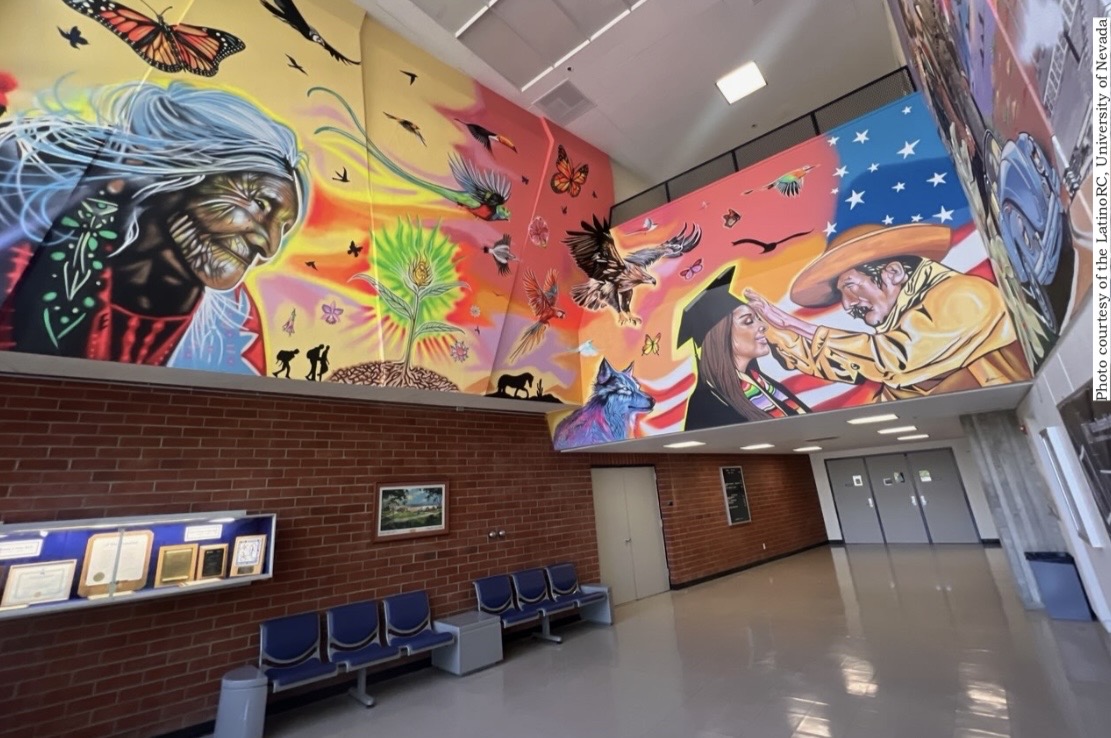
As the Latino population continues to shape Nevada’s landscape, the LRC fills an essential knowledge gap. Its work helps explore what Nevada’s future can look like when Latino communities have a voice in shaping it. A recent mural unveiling further reinforced the LRC’s position at the intersection of research, higher education, and community engagement. That role aligns closely with the broader mission of the University of Nevada, Reno, a land-grant institution committed to learning, discovery and engagement, helping others contribute to their communities and the world.
About the author
Jafeth E. Sanchez, PhD, Associate Professor of Educational Leadership, is a three-time University of Nevada, Reno graduate and the Director of the Latino Research Center. Her research focuses on educational leadership, organizational change, and equitable outcomes across P-20 pathways.