The United States has historically been recognized for the openness of its higher education institutions to the world, and the plethora of opportunities offered for American students to gain a deeper understanding of diverse global cultures – through Area Studies programs, study abroad experiences, foreign language scholarships, regional cooperative agreements, and college-based cultural centers. At a time when programs related to cross-cultural, global learning are being devalued through divisive political discourses and eroded by funding cuts, it is especially important to gain a better understanding of what these programs consist of, beginning with the basic data necessary to ground any discussion.
This three-part series of articles focuses on the overlapping areas of Latin American and Caribbean Studies, Spanish Language and Literature, and Mexican-American, Chicano and Latino Studies, which all contribute to deeper knowledge about issues that are arguably essential for the United States: its neighbouring region, the composition of its largest ethnic minority, and the language spoken not only in 21 countries across the globe, but also by more than 40 million people within the U.S., making it the second largest Spanish-speaking country in the world.
In the first part of this series, we offered readers an overview of Latin American and Caribbean Studies (LACS) programs at U.S. higher education institutions (see February 2025 issue), by providing precise data on the historical evolution and current number of these programs across the country, as well as a list of institutions that award the largest number of degrees and certificates in this area. In this issue, we present similar data for Spanish Language and Literature (SLL) programs, which provide thousands of students across the country – at community colleges, 4-year universities and across all levels from certificates to doctorates - with the opportunity not only to learn to communicate in Spanish, but also to gain access to a new world of cultural richness that the knowledge of any language unlocks.
Each part of this series also includes data on the participation of Hispanic/Latino students, in order to obtain a broader picture of the ways in which Hispanics/Latinos are taking the opportunity to expand knowledge of their roots as “heritage learners” in higher education, as well as to identify the specific institutions that produce the largest numbers of Hispanic/Latino graduates in these areas.
Data on Spanish Language and Literature (SLL) Programs: Defining Specific Parameters
Specific IPEDS Classification of Instructional Programs (CIP) Codes were used to narrow the parameters of the field. In the broad IPEDS area of Foreign Languages, Literatures and Linguistics, the Romance Languages, Literatures and Linguistics category was selected (CIP Code 16.09). Within this category, the descriptor Spanish Language and Literature (CIP Code 16.0905) was selected. For this sub-category of study, there is data on the number of degrees and certificates granted, which includes all levels of study (from one-year certificates to full doctoral degrees), and both first and second majors. The data for first and second majors was combined, to give a total number of all degrees and certificates granted in Spanish Language and Literature (SLL) Studies.
However, there are limitations and gaps in this data which must be noted. It is challenging to isolate data specifically on Spanish Language and Literature programs, given that this area often overlaps or is paired up with numerous other programs such as Latin American and Caribbean Studies, Hispanic/Iberian Studies, Latin American Languages (which includes Portuguese, French and native languages), and Latino/Chicano/Mexican-American Studies, among others, which are reported to IPEDS under different IPEDS CIP codes. In addition, students may major in Spanish as part of entirely different, broader programs (such as International Relations, Ethnic Studies, Interdisciplinary Studies, World Literature, etc.), which also belong to completely separate IPEDS categories. Finally, since this IPEDS historical and comparative database only includes students who obtain awards of completion (degrees or certificates) in each area of studies, it leaves out students who study Spanish as minors or concentrations within broader degrees. It also leaves out institutions that may have a Spanish Language and Literature program, but did not award degrees or certificates in the specific academic years consulted, and are thus not included in the IPEDS dataset; this might be particularly prevalent among smaller institutions or those that engage in more research than teaching.
Evolution of Spanish Language and Literature Degrees/Certificates and Reporting Institutions Over the Past Two Decades
A Declining Trend in Total SLL Degrees/Certificates
Our analysis of IPEDS historical data for nine intervals of academic years between 2003-04 and 2023-24 shows that between 2003-04 and 2008-09, there was an increase in the total number of SLL degrees/certificates. However, there has been a steady decline in these degrees/certificates since then. Indeed, 3,626 fewer SLL degrees/certificates were awarded in 2023-24 than they were two decades ago (2003-04), representing a striking decrease.
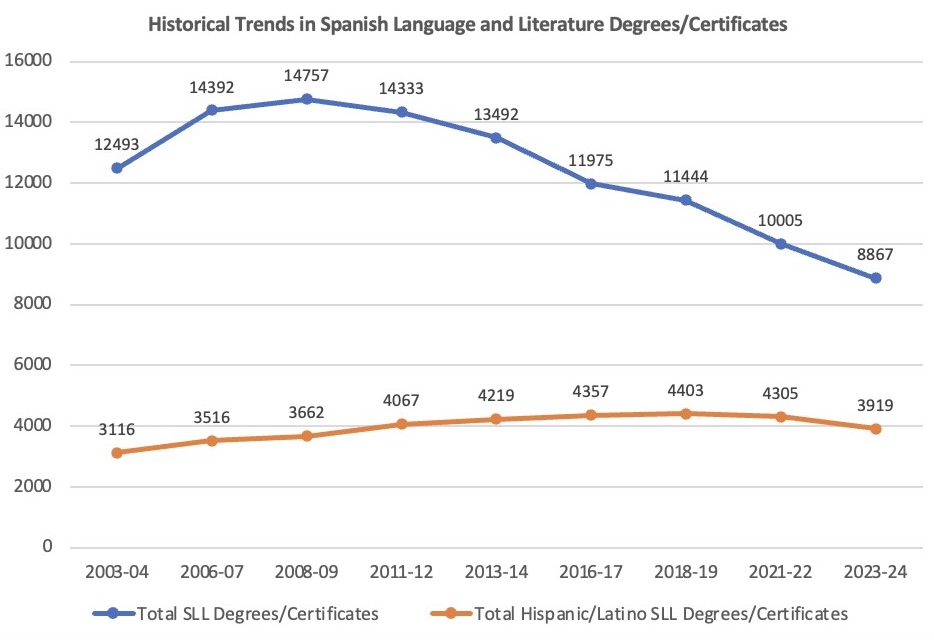
While slow recovery after the Covid19 pandemic may account for the reduction in 2021-22 and even into 2023-24, it does not account for the fact that these numbers were already in decline since 2008-09, a decade before the pandemic. More research is needed to understand the reasons behind this notable decline in the number of reported SLL degrees/certificates, and whether these are related merely to reporting issues (institutions changing the scope of SLL programs or joining them with other areas, for example), or to a decline in interest or funding for the field of Spanish Language and Literature itself.
SLL Degree/Certificate Granting Institutions: Trends and Characteristics
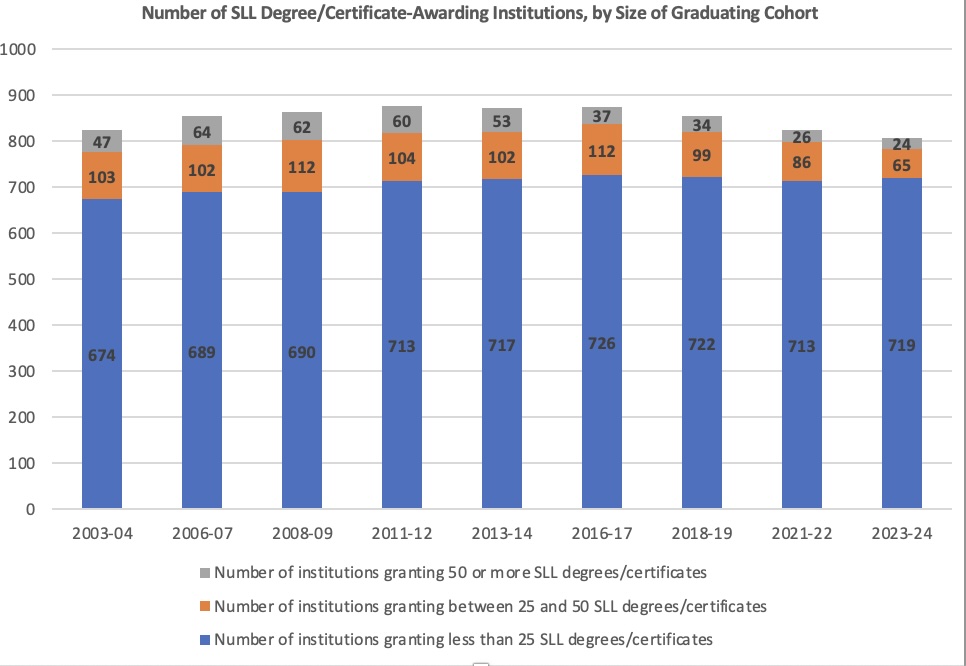
As with the number of SLL degrees/certificates, there was an increase in the number of institutions with Spanish Language and Literature programs (those reporting one or more SLL degrees/certificates), between 2003-04 and 2011-12, but the number of these institutions has also decreased from a high of 877 at that time to 808 in the most recent reporting year (2023-24). This number is lower than it was in 2003-04, when there were 824 such institutions, indicating a considerable reduction.
Data over the past two decades shows that the proportion of institutions that have large Spanish Language and Literature programs (awarding 50 or more SLL degrees/certificates) has always been quite small, representing less than 8% of all SLL degree/certificate-granting institutions. Indeed, in this time period, even the number of institutions that award 25 or more SLL degrees/certificates has never exceeded 20% of all SLL-awarding institutions. Thus, most SLL degree/certificate-awarding institutions have SLL programs of a very moderate size. In recent years, this tendency has increased; in 2023-24, 89% of all listed SLL institutions granted fewer than 25 SLL degrees/certificates each.
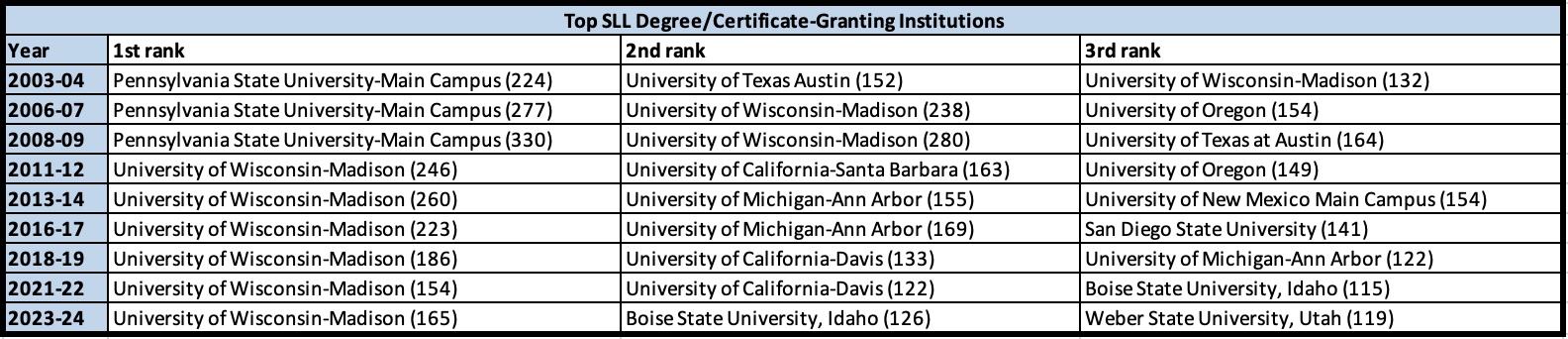
In addition, it is notable that the top SLL degree/certificate-granting institutions had larger numbers until 2016-17, with more than 220 SLL degrees/certificates each; these have been dwindling over the past decade to less than 170 for each institution. While the University of Wisconsin-Madison has retained its dominance in this area over the past two decades, the other top-ranked institutions in terms of total SLL degrees/certificates have varied considerably and are spread across all regions, ranging from universities in Texas, California and New Mexico to ones in Pennsylvania, Oregon and Michigan, and most recently, in Idaho and Utah.
Growth of Hispanic/Latino “Heritage Learners” in SLL Studies
Data for the past two decades shows that the number of SLL degrees/certificates conferred to Hispanic/Latino students increased steadily between 2003-04 and 2018-19, and then had a slight reduction since then, possibly due to the effects of the Covid19 pandemic. It is notable that while the overall number of SLL degrees/certificates has dipped considerably, the number of SLL degrees/certificates granted to Hispanics/Latinos has not had a drastic reduction, even after the pandemic. Indeed, the number of Hispanic/Latino SLL degrees/certificates is still higher in 2023-24 than it was in 2008-09, and has almost recovered to 2011-12 levels (see graph above).
At the same time, the proportion of SLL degrees/certificates granted to Hispanic/Latino students has increased dramatically, from only 25% of the total in 2003-04 to nearly half of the total (44%) in 2023-24.
As with Latin American and Caribbean (LAC) Studies (see February 2025 issue), Hispanic/Latino participation in Spanish Language and Literature programs has clearly grown over the past two decades. Both of these upward trends could be explained as a natural result of Hispanic/Latino demographic growth and greater Hispanic/Latino attainment in higher education overall; they could also be seen as part of broader interest among these students in valuing and exploring their roots, as “heritage learners”. It would be interesting to conduct further research on the motivations of Hispanic/Latino students for joining SLL programs, as well as finding data on the growth of “Heritage Language” programs which take into account the specific background and learning goals of this rapidly growing proportion of Hispanic/Latino students in Spanish Language and Literature studies.
At the same time however, as with Latin American and Caribbean Studies, research on the growing predominance of Hispanic/Latino students in these areas should be complemented by research into the concomitant decrease in the participation of other ethnic groups, which might signal their decreasing interest in learning foreign languages, point to a wider trend wherein members of each ethnic group retreat into their own cultural silos rather than venturing to learn more about others, or reveal other factors.
Institutions with the largest numbers of SLL degrees/certificates conferred to Hispanic/Latino students have varied over the past two decades, although San Diego State University has appeared in the top three ranks most consistently. In contrast with the top ranking institutions for SLL degrees/certificates overall, those with the largest numbers of Hispanic/Latino SLL degree/certificate recipients are located primarily in only a few states (California, Texas, New Mexico and Arizona).
The Spanish Language and Literature Landscape Today
Top SLL Degree/Certificate-Granting Institutions Overall
The following list includes all institutions that reported more than 50 SLL degrees/certificates in the 2023-24 academic year, ranked according to the grand total of degrees/certificates granted:
These top SLL Degree/Certificate-Granting institutions have the following characteristics:
· All are 4-year schools, except for San Joaquin Delta College, which is a 2-year school
· The vast majority are public (only Brigham Young University and the University of Notre Dame are private)
· They are widely spread out across the country (in 15 states), rather than being concentrated in any single state or region (although notably, none are located in the Northeast)
· Ten of these institutions have a large proportion of Hispanic/Latino SLL degree/certificate recipients (more than half of all SLL degree/certificate recipients).
Top SLL Degree/Certificate-Granting Institutions for Hispanics/Latinos
These top SLL Degree/Certificate-Granting institutions for Hispanics/Latinos have the following characteristics:
· All are public 4-year schools, except for San Joaquin Delta College and Southwestern College, which are both public 2-year schools
· They are found in 9 states across the country, but the largest proportion (63%) are in California (17 institutions)
· At the majority (25 of 27) of these institutions, Hispanics/Latinos represent more than half of all SLL degree/certificate recipients