Middlebury’s Schools Abroad in Latin America embody a deep commitment to intercultural immersion and experiential learning. Drawing on the institution’s legacy of language and global education, its programs in Argentina, Brazil, Chile, Puerto Rico, and Uruguay allow students to not only advance their academic studies but also experience the everyday life, language, and social fabric of their host communities. Each site presents a distinctive opportunity for linguistic growth, cultural understanding, and intellectual engagement, all while students live and learn as part of the host university’s culture.
Students adhere to the Middlebury Language Pledge®, a formal commitment to communicate exclusively in the host-country language throughout their stay. This total immersion approach fosters linguistic fluency, cultural empathy, and confidence, encouraging participants to engage authentically with people and ideas different from their own.
Argentina: Academic Rigor Amid Cultural Vibrancy
The Middlebury School in Argentina, based in Buenos Aires, invites students into one of Latin America’s most cosmopolitan cities. Students take courses alongside Argentine peers in disciplines such as political science, literature, international relations, and economics, while also exploring volunteer or internship opportunities.
Beyond academics, Buenos Aires itself becomes a laboratory of cultural discovery. From the colorful murals of La Boca neighborhood to the elegant boulevards of Recoleta, students quickly come to see how tango music, literary movements and social activism intertwine to express a national identity grounded in creativity and resilience.
Brazil: Understanding Diversity Through Language and Society
Brazil’s locations in Florianópolis, renowned for its stunning beaches, ecological richness, and relaxed coastal culture, and Niterói, just across the bay from the vibrancy of Rio de Janeiro, offer a cross-section of the country. Students study entirely in Portuguese, an immersive challenge that quickly yields rewards in language acquisition and depth of expression. Coursework spans social sciences, environmental studies, and cultural studies, often highlighting Brazil’s racial diversity, musical traditions, and socio-political transformations.
Because Brazil’s identity is shaped by Indigenous, African, and European influences, students gain a multifaceted understanding of cultural hybridity and complexity. The student excursion takes participants into rural communities and environmental reserves, deepening their appreciation for Brazil’s biodiversity and the environmental issues that define its national discourse.
Chile: Learning Amid History and Natural Beauty
The Middlebury School in Chile offers opportunities in seven cities from Valparaíso to Valdivia, providing students with both metropolitan and coastal perspectives on Chilean culture.
Chile’s varied geography mirrors its social and cultural diversity. Students may hike in the Andes, explore the legacy of poet Pablo Neruda, or conduct research on social movements and historical memory. The program emphasizes independent inquiry and civic engagement, encouraging students to apply classroom learning through community-based projects.
Lola Henderson-Thomas highlights her Education, Culture, and Nature class, focused largely on effective communication and incorporating all perspectives into the conversation to allow everyone to engage and learn. “My professor challenged us to have hard conversations and an open mind to create welcoming spaces for learning in ourselves. I began to see education more as a relationship that is influenced by culture, community, and communication. Being able to create and engage in welcoming and supportive spaces has reshaped how I think about science communication and how to best educate myself and others.”
Through various experiences, participants come to recognize the resilience and depth of Chile’s cultural identity: a mix of Indigenous heritage, colonial history, and modern innovation.
Puerto Rico: Language, Identity, and Culture in the Caribbean
The Middlebury School in Puerto Rico provides an ideal site for exploring questions of language, identity, and colonial legacies. Students enroll directly in local institutions in San Juan and Mayagüez where they take courses in humanities, natural sciences, and social sciences. The program encourages students to participate in local organizations, giving them insight into Puerto Rico’s cultural vibrancy and civic life.
Francisco Tellez recalls a particularly memorable experience:
“Our group traveled to Ponce for one of our excursions. We participated in the annual Carnaval complete with food carts, live music, and of course, a parade. Sitting and watching groups of children and performers walk by, showcasing their talent and unique culture, really made me feel grateful to have chosen the Puerto Rico program because it gave me a chance to see that what made the island so special was the people who lived there.”
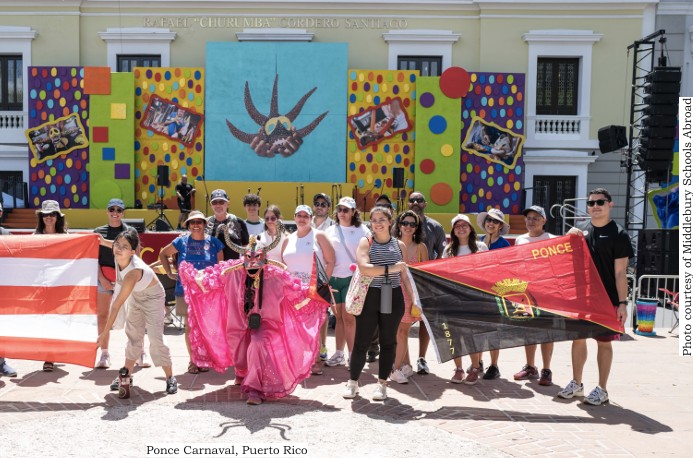
Through experiences like the Carnaval de Ponce, students discover that learning abroad extends far beyond the classroom—it’s about engaging with the people whose lives and stories shape the place itself.
Uruguay: Small Country, Big Discovery
Often considered one of South America’s best-kept secrets, Uruguay offers students an experience that combines intellectual challenge with a warm, accessible atmosphere.
Montevideo, host city of the Middlebury School in Uruguay, blends historic architecture with progressive social values, offering a unique setting to study democracy, sustainability, and cultural policy. From its coastal ramblato its vibrant music scene, Montevideo encourages curiosity and connection.
Students live with host families, participate in volunteer projects, and explore the country’s cultural treasures, from mate-sharing to the traditions of candombe, a musical expression rooted in African heritage. The result is a profound appreciation of how a small nation can make a powerful mark through its commitment to equality and community.
Transformative Experiences, Lifelong Connections
The Middlebury Schools Abroad in Argentina, Brazil, Chile, Puerto Rico, and Uruguay exemplify what global education can achieve when based on immersion, respect for host cultures, and curiosity. Whether dancing tango in Buenos Aires, volunteering in Montevideo, or exploring the rainforest near Florianópolis, students find that the world is not a classroom—it is the lesson itself.
By living the language, embracing new perspectives, and engaging with communities across Latin America, students return home not just more fluent speakers, but also more empathetic, connected, and globally aware individuals prepared to shape a more understanding world.
About the author
Nicole Chance has worked with the Middlebury Schools Abroad since 2003. A former Peace Corps volunteer (Guinea, education) who also spent one year with her family in Florianópolis, Brazil, she knows what it means to embrace a new language and culture and appreciates being able to share these learning opportunities with students eager to do the same.