Just as we begin a new year by setting our sights on higher goals and aspirations, at H.O. our January issue is dedicated to exploring the highest levels of education - graduate studies. Although Hispanics/Latinos are still under-represented at this level, indicating the much work needs to be done to broaden pathways between undergraduate and graduate education, we are nonetheless inspired by the slow but steady growth in the number of Hispanic/Latino students who embark upon Master’s and PhD programs, often despite challenging circumstances.
We also recognize, each year, the institutions that enroll and graduate the largest numbers of Hispanic/Latino students at the graduate level. Data on these top 50 institutions not only provides us with concrete lists of colleges and universities that serve the largest number of Hispanic/Latino graduate students – it also sheds light on trends in Hispanic/Latino graduate participation overall.
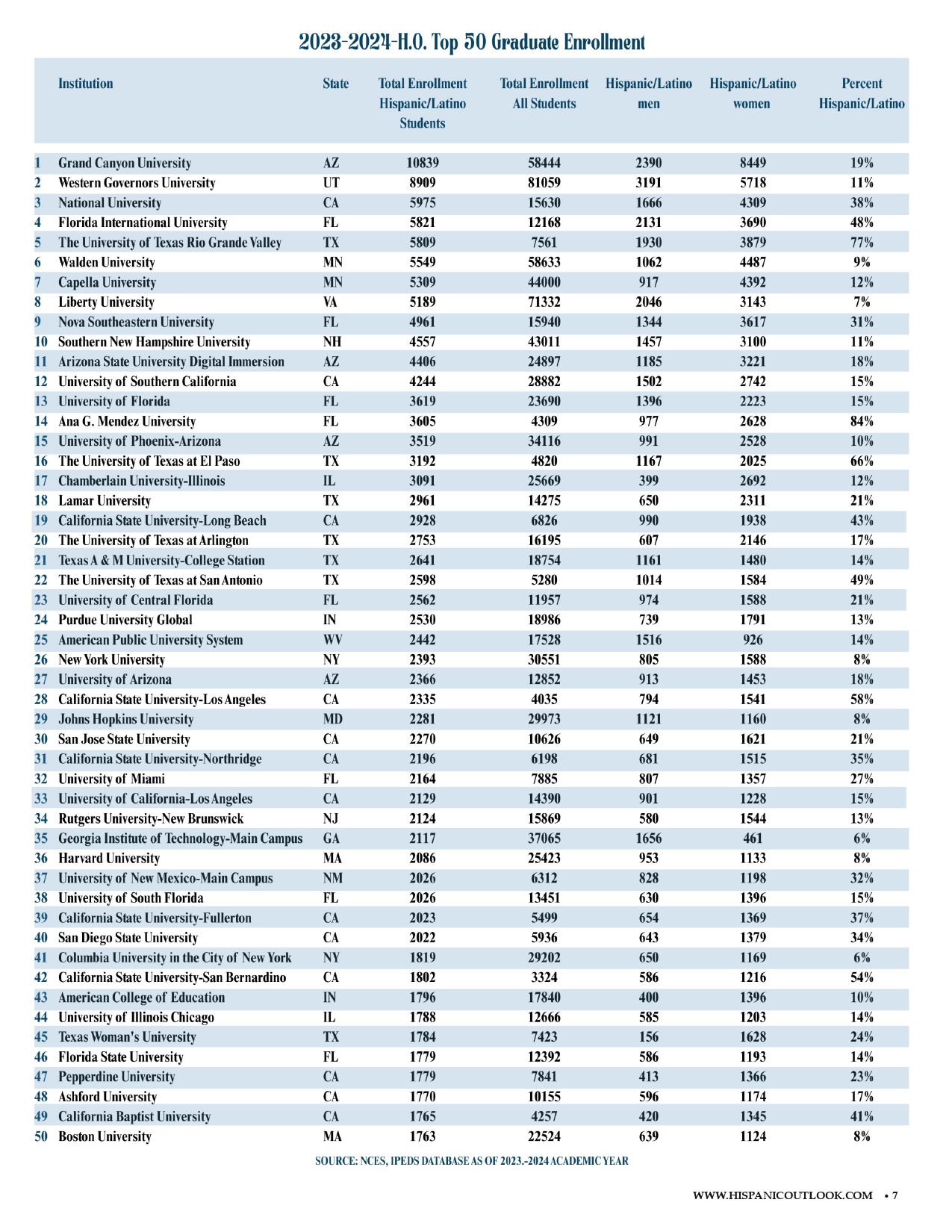
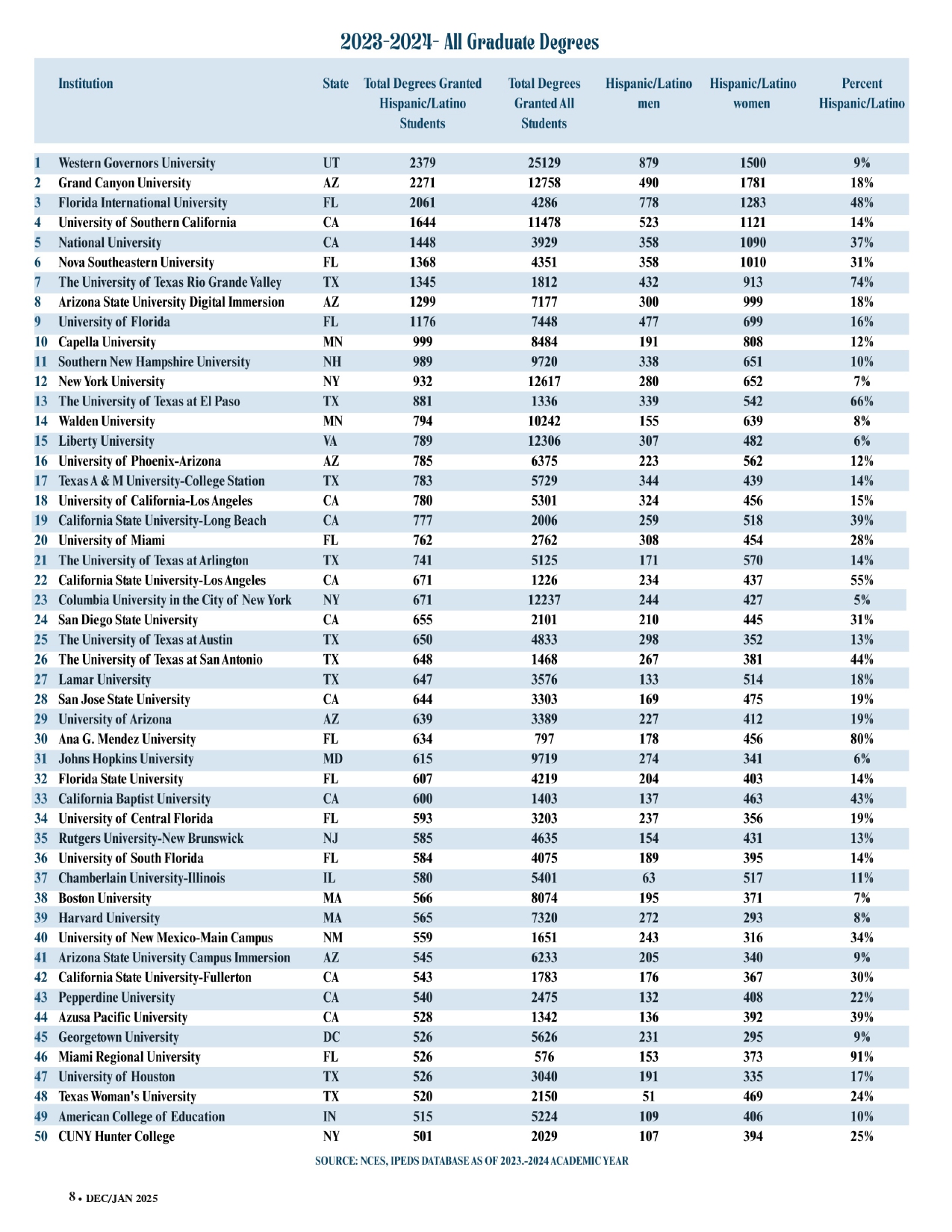
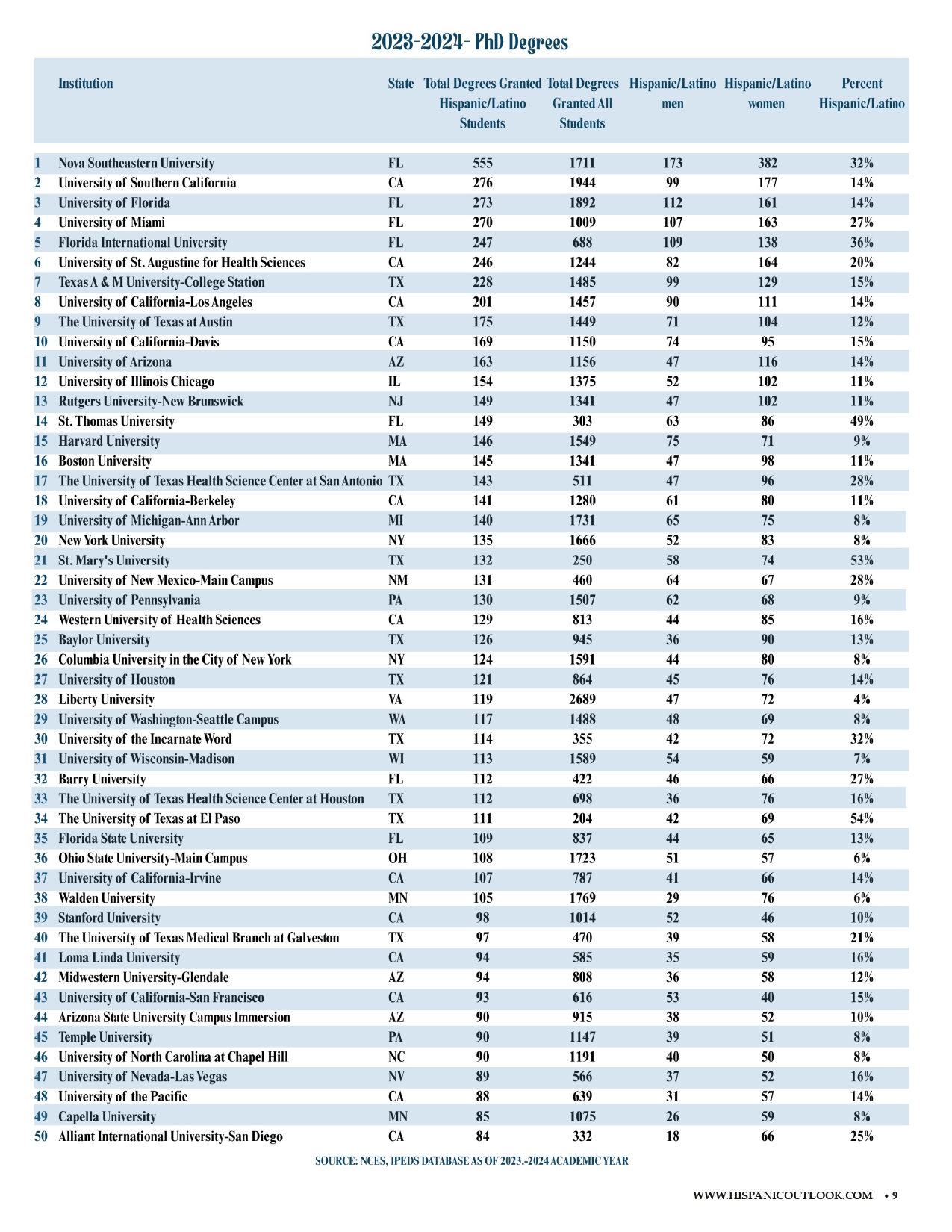
The following three lists are based on our analysis of 2023-24 data from the NCES Integrated Postsecondary Education Data System (IPEDS). This is the most recent data made available by IPEDS since October 2025. For the 2023-24 academic year, our three lists include:
• Top 50 schools with the highest number of overall Hispanic/Latino graduate enrollments, which includes all doctoral and master’s programs, full and part time enrollments, enrollments by degree- and certificate-seeking students, and enrollments in graduate courses by non-degree/certificate-seeking students
• Top 50 schools with the highest number of graduate degrees granted to Hispanic/Latino students, which includes master’s degrees and all categories of PhD degrees
• Top 50 schools with the highest number of PhD degrees granted to Hispanic/Latino students - including PhDs for research/scholarship, for professional practice, and for other purposes
Hispanic/Latino Graduate Enrollments
The most recent data indicates a continuing trend of modest but steady growth in Hispanic/Latino graduate enrollments. In the 2023-24 academic year, the top 50 schools listed here enrolled 160,412 Hispanic/Latino students in all graduate programs, 9,971 more than in the 2022-23 academic year. This continues an upward trend: there was an increase of 4,068 Hispanic/Latino graduate students between 2021-22 and 2022-23, and of 6,062 of these students between 2020-21 and 2021-22.
In 2023-24, the top 10 of these 50 institutions enrolled more than 4,500 Hispanic/Latino graduate students each; the top two - Grand Canyon University, Western Governors University – stand out for enrolling a considerably larger number that all other institutions (10,839 and 8,909 respectively).
With regard to the sector of these top Hispanic/Latino graduate-enrolling schools, it is interesting to note that only a narrow majority are public; a greater proportion of them are private than is generally the case among top Hispanic/Latino undergraduate-enrolling schools. Among the top 50 institutions listed here, 27 are public, 15 are private non-for-profit institutions, and the remaining 8 are private for-profit schools. Notably, 8 of the top 10 of these schools are private.
These top Hispanic/Latino graduate-enrolling schools are located across all regions; however, the highest concentration is in California (13), followed by Florida (8) and Texas (7). Thus, more than half of these top 50 institutions are located in these three states.
This list reveals a notably higher enrolment of Hispanic/Latino women in graduate programs than Hispanic/Latino men, part of a continuing trend over the past years. Similarly to last year, more than two-thirds (68%) of all Hispanic/Latino graduate students enrolled at these top 50 institutions were women (109,364), while less than one-third (32%) were men (51,048).
Hispanic/Latino graduate students continue to represent a relatively small proportion of all graduate students at the majority of these 50 institutions. As in previous years, at two-thirds of these 50 institutions (34 of them), Hispanic/Latino graduate students constituted less than one-quarter of the total number of graduate students.
Indeed, Hispanic/Latino students represented a large proportion of the graduate student body (more than half) at only five schools: Ana G. Mendez University in Florida (84%), the University of Texas Rio Grande Valley (77%), the University of Texas at El Paso (66%), California State University Los Angeles (58%), and California State University San Bernardino (54%). Another eight institutions had Hispanic/Latino students comprising more than a third of all graduate students.
Graduate Degrees Granted to Hispanic/Latino Students
The top 50 institutions on this list conferred 41,986 graduate degrees to Hispanic/Latino students in the 2023-24 academic year, only 583 more than in 2022-23. This represents slower growth than the previous year, when 1,991 more graduate degrees were granted than the year before (2021-22).
In 2023-24, each one of the top 10 of these institutions conferred 999 or more graduate degrees to Hispanic/Latino students. The top three schools – Western Governors University, Grand Canyon University and Florida International University - conferred more than 2,000 graduate degrees each.
Given that a greater number of Hispanic/Latino women than men were enrolled in graduate programs, it is unsurprising that two-thirds (68%) of all graduate degrees for Hispanics/Latinos were conferred to women. Hispanic/Latino women received a total of 28,733 graduate degrees at these top 50 institutions, while men received a total of only 13,253.
As with graduate enrollments, the majority (33) of these top 50 schools granted less than one-quarter of all graduate degrees to Hispanic/Latino students. At the same time, Miami Regional University stands out for conferring the largest proportion of graduate degrees to Hispanic/Latino students (91%), followed by Ana G. Mendez University in Florida (80%) and the University of Texas Rio Grande Valley (74%).
PhD Degrees Granted to Hispanic/Latino Students
In 2023-24, a total of 7,317 PhD degrees were granted to Hispanic/Latino students at all 50 top institutions on this list. This continues the modest increase that has occurred over the past few years: in 2022-23, 6,779 PhD degrees were granted to Hispanic/Latino students at the top 50 institutions; in 2021-22, 6,357 of these degrees were granted, and 6,086 were granted in 2020-21.
The number of PhD degrees granted to Hispanic/Latino students remains low overall, with each institution on this list granting between 84 and 276; only Nova Southeastern University granted more than 500.
With regard to gender, the gap between Hispanic/Latino women and men persists at the PhD level, although it is not as wide as it is with graduate enrolment or graduate degrees overall. The total number of PhD degrees conferred to Hispanic/Latina women at all 50 institutions was 4,468 (representing 61% of the total), while men were awarded a total of 2,849.
The proportion of Hispanic/Latino PhD recipients out of all PhD recipients is quite small (less than one-quarter) at most of these 50 institutions (39 of them, or 78%). The schools on this list that conferred the largest proportion of doctoral degrees to Hispanic/Latino students, out of all the doctoral degrees they awarded, were the University of Texas at El Paso (54%), St. Mary’s University in Texas (53%), and St. Thomas University in Florida (49%).
Among these 50 top PhD degree-granting institutions for Hispanics/Latinos, 27 are public institutions, 19 are private not-for-profit schools, and the remaining 4 are private for-profit schools. With regard to their location, the largest number are in California (12), followed by Texas (10) and Florida (7).