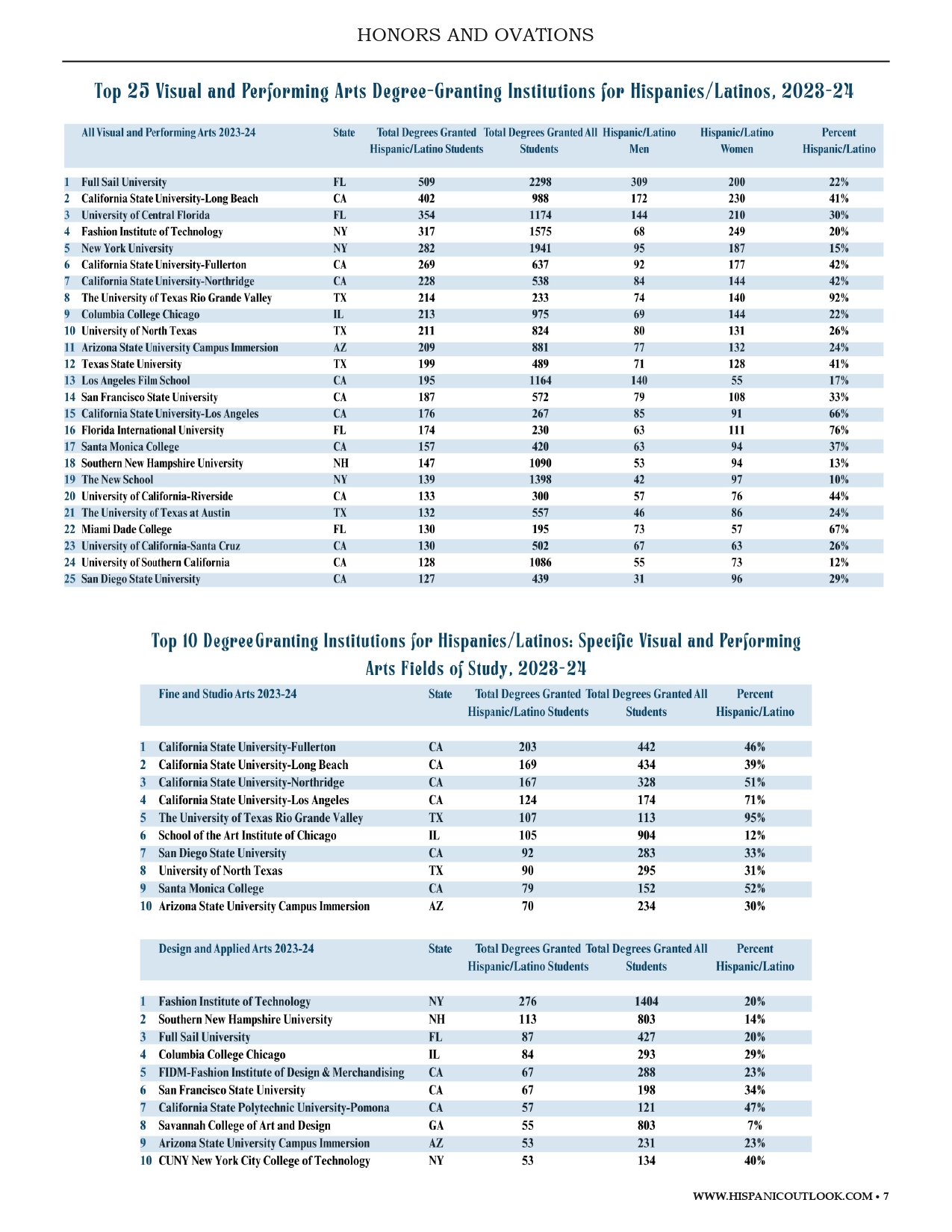
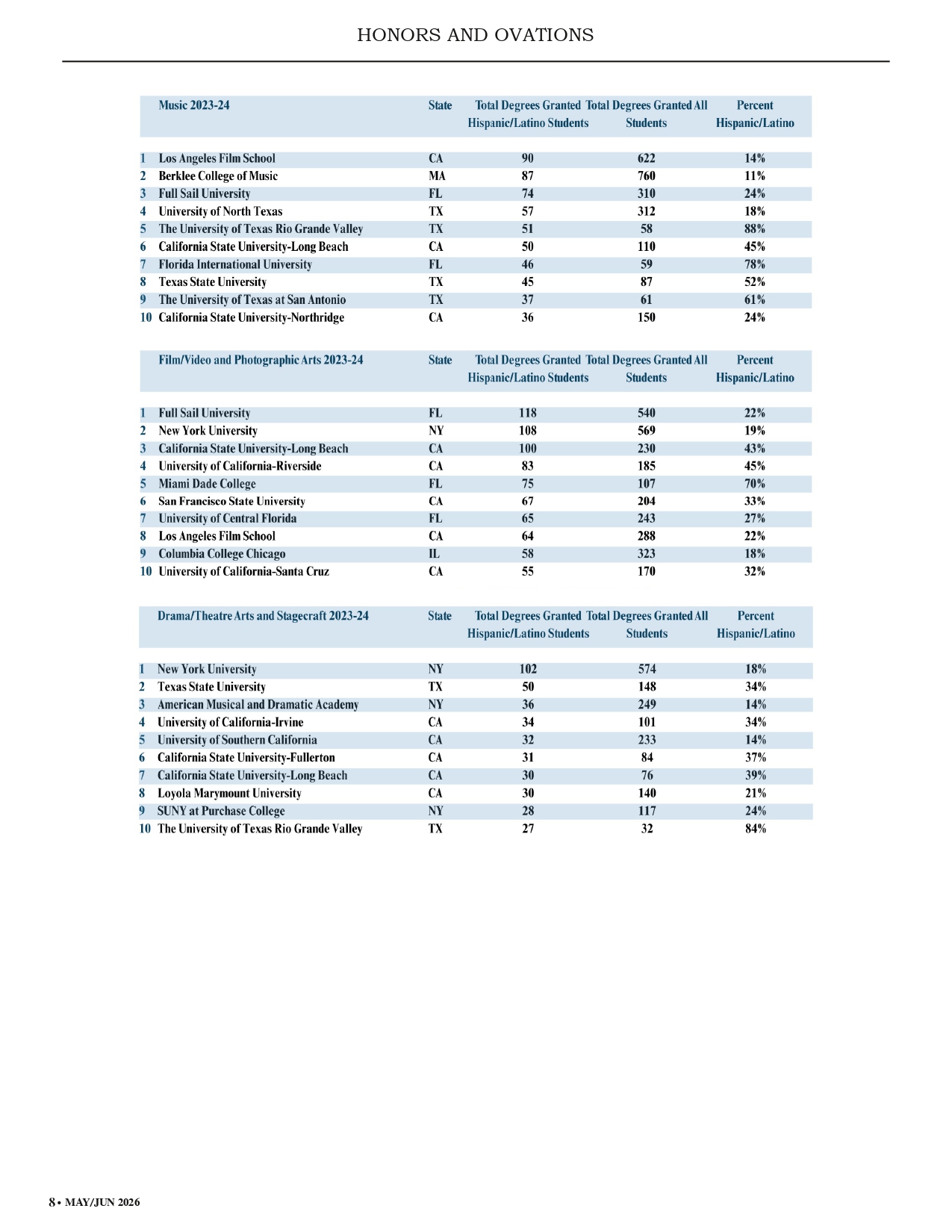
The articles in this issue illustrate the vibrancy of programs dedicated to including Hispanic/Latino students in the visual and performing arts, and to highlighting their cultural contributions to this area. In light of this issue’s theme, and as part of Hispanic Outlook’s commitment to presenting readers with concrete data on Hispanic/Latino students in higher education, the following pages provide an overall profile of their presence in visual and performing arts programs.
This analysis is based on data from NCES’ IPEDS for 2013-14, 2018-19 and 2023-24 (the latest year available) on degrees granted (at all levels) in the broad category of Visual and Performing Arts. This data is then disaggregated into 9 more specific fields of study included by IPEDS within this category: General Visual and Performing Arts; Arts, Entertainment and Media Management; Dance; Film/Video and Photographic Arts; Drama/Theater Arts and Stagecraft; Music; Design and Applied Arts; Fine and Studio Arts; and Other Visual and Performing Arts (which, for the purpose of this analysis, includes the fields of Crafts/Craft Design, Folk Art and Artisanry, and Community/Environmental/Socially-Engaged Art, given that these have a very small number of degrees).
Growth of Hispanic/Latino Students’ Presence in Visual and Performing Arts
An analysis of degrees granted in the broad category of Visual and Performing Arts for the years 2013-14, 2018-19 and 2023-24 reveals that:
· The total number of degrees granted to Hispanic/Latino students increased by more than 10,000 over the past decade (from 12,409 in 2013-14 to 22,592 in 2023-24), at a faster rate than the overall growth of degrees in this category (granted to all ethnicities), which increased by less than 3,000 over the same period (from a total of 126,285 in 2013-14 to 129,127 in 2023-24). Thus, Hispanic/Latino degree-holders represent a growing proportion of all Visual and Performing Arts degree-holders (increasing from 10% of total degrees in 2013-14 to 14% in 2018-19, and 17% in 2023-24).
· With regard to levels of study, for each of these years the largest proportion of all Visual and Performing Arts degrees has been granted at the Bachelor’s level, followed by Associate’s degrees, Master’s Degrees, and a very small proportion of Doctor’s degrees. A similar distribution can be seen among degrees granted to Hispanics/Latinos, with the largest number by far at the Bachelor’s level for all the years analyzed (representing between 66% and 69% of all Hispanic/Latino degrees). The proportion of Associate’s degrees has increased slightly, from 22% to 26% of total Hispanic/Latino degrees, but the proportions of Master’s and Doctor’s degrees have remained nearly the same and are very low (around 7% of the total for Master’s, and less than 1% for Doctor’s degrees).
· Hispanic/Latino degree-holders have increased as a proportion of total Visual and Performing Arts degree-holders at all levels of study, with a particularly marked increase at the Associate’s level (where Hispanics/Latinos went from less than one-fifth of total degree-holders in 2013-14 to more than one-quarter of the total in 2023-24). There has been slow growth at the Doctoral level, however, with Hispanic/Latino degree-holders remaining at only between 4 and 5% of all Doctor’s degree holders in this area (see Graph 1).

· With regard to gender, there has been a slightly larger proportion of Hispanic/Latino women than men obtaining degrees in Visual and Performing Arts; this percentage has not changed substantially over the past decade (increasing from 57% of total Hispanic/Latino degree-holders in 2013-14 to 61% in 2023-24).
The Current Landscape: Top Degree-granting Institutions for Hispanic/Latino Students in Visual and Performing Arts
Data on Visual and Performing Arts degrees granted in 2023-24 (the latest year currently available) indicates that:
· A total of 22,592 degrees in this area were awarded to Hispanic/Latino students, at 1,417 institutions. Of these degrees, 5,362 (nearly a quarter, 24%) were awarded by the top 25 institutions listed here, indicating a high concentration of Hispanic/Latino Visual and Performing Arts students in a relatively small number of schools. These 25 top Hispanic/Latino degree-granting institutions are mostly public (18), and they are located primarily in California (11), although the remaining schools are spread across several states, including New York, Texas and Florida.
· Among these top 25 institutions, those with the highest proportion of Hispanic/Latino degree recipients as a percentage of all Visual and Performing Arts degree recipients are the University of Texas Rio Grande Valley (92%) and Florida International University (76%).
· At all 1,417 institutions, Hispanic/Latino men were awarded 8,834 degrees in Visual and Performing Arts, while 13,758 degrees were conferred to Hispanic/Latino women (61% of all Hispanic/Latino degrees)
· The majority of Visual and Performing Arts degrees for Hispanic/Latino students were conferred at the Bachelor’s level (15,081), followed by the Associate’s level (5,927); very few degrees in this area were awarded to Hispanics/Latinos at the Master’s and Doctor’s level (1,485 and 99 respectively).
A Closer Look: Degrees Granted to Hispanic/Latino Students in Specific Fields of Study
As previously mentioned, there are 9 areas of study within the broad category of Visual and Performing Arts. Overall, the highest number of degrees are granted in Fine and Studio Arts, Design and Applied Arts, and Music. This is also true for degrees granted to Hispanics/Latinos in particular, with nearly two-thirds of all Hispanic/Latino Visual and Performing Arts degrees awarded in these three areas (see graph 2 below). In 2023-24, 6,785 degrees were awarded to Hispanic/Latino students in Fine and Studio Arts, followed by 4,780 degrees in Design and Applied Arts, 3,122 in Music, and 2,858 in Film/Video and Photographic Arts. The lowest number of degrees were granted in Dance (465) and in Other Visual and Performing Arts (only 97).
Degrees awarded to Hispanic/Latino students represent more than 20% of all degrees granted in the fields of General Visual and Performing Arts (24%) and in Fine and Studio Arts (22%), while they represent much lower proportions in Music (13%), as well as in Arts, Entertainment and Media Management (13%).