At the University of California, San Francisco, Fresno Regional Campus, the Office of Health Career Pathways (OHCP) team works diligently to address the workforce shortages in the San Joaquin Valley (SJV). Many of the communities served have long been designated as Health Professional Shortage Areas (HPSA’s). HRSA (Health Resources and Services Administration) notes that “about 20 percent of the U.S. population resides in primary medical care HPSAs. HPSAs may have shortages of primary medical care, dental, or mental health providers; may be urban or rural areas; population groups; or medical or other public facilities.” OHCP directly addresses this via culturally responsive and regionally rooted health career pathway programs and opportunities designed to better serve students in the area throughout the K-16 educational system. For over 30 years, UCSF Fresno has housed multiple pathway programs and opportunities that develop the future health workforce through upstream interventions.
Katherine Flores, MD, a now retired Family Medicine physician who completed her residency at UCSF Fresno, started the Latino Center for Medical Education and Research (LaCMER) department in 1996, initially to address the shortage of Latino physicians in the SJV. Through her work, she developed high school pathway programs like the Doctors Academy program in 1999. Since then, over 1,200 students have completed the program, and many are physicians, nurses, allied health professionals and mental health providers in the area. To address the growing number of pathway programs and opportunities for the K-16 community within the university, the department restructured into what is now the Office of Health Career Pathways (OHCP) in 2022.
This article offers an opportunity to highlight programming focused on supporting middle school, high school, college and gap year students in the San Joaquin Valley who aspire to pursue careers in health. We share key accomplishments, lessons learned, and ongoing challenges, in the hope that this article provides a meaningful picture of both impact and growth, with insights on how to support communities with similar population demographics. In addition, we highlight student voices that have been impacted by our work.
In 2025, the State of California, Department of Finance reported that approximately 58% of the population in the San Joaquin Valley identifies as Hispanic/Latino (Projections | California Department of Finance) compared to the overall state average of 39% in the same year.
Currently, OHCP’s staff supports over 2,000 students annually across different stages of the educational pipeline, through more than a dozen programming initiatives (Learn more at: https://sjvpremed.ucsf.edu/).While specific numbers vary by year, our programs have consistently engaged cohorts of middle school, high school and college students, a majority of whom are the first in their family to pursue college and/or a career in health professions. One of our longest standing programs, the year-round, 4-year UCSF Fresno Doctors Academy, contracts with local schools to offer work-based learning opportunities that include guest speakers, trips to universities and health professional schools, job shadowing, training and certifications, and college preparation, among many other activities.
Health pathway programs like the DA program have flourished across the nation through an influx of investment and funding from federal, state and private entities over the last 20 years. In the San Joaquin Valley, a notable example has been the SJV PRIME+ BS/MD program at the University of California, Merced campus, in partnership with UCSF School of Medicine and UCSF Fresno. This eight-year program targets high school seniors, who join a cohort of 12-15 students from the San Joaquin Valley; they learn and train entirely in the region. This program, launched in fall 2023, and pathway programs like the Doctors Academy, prepare students from underserved communities.
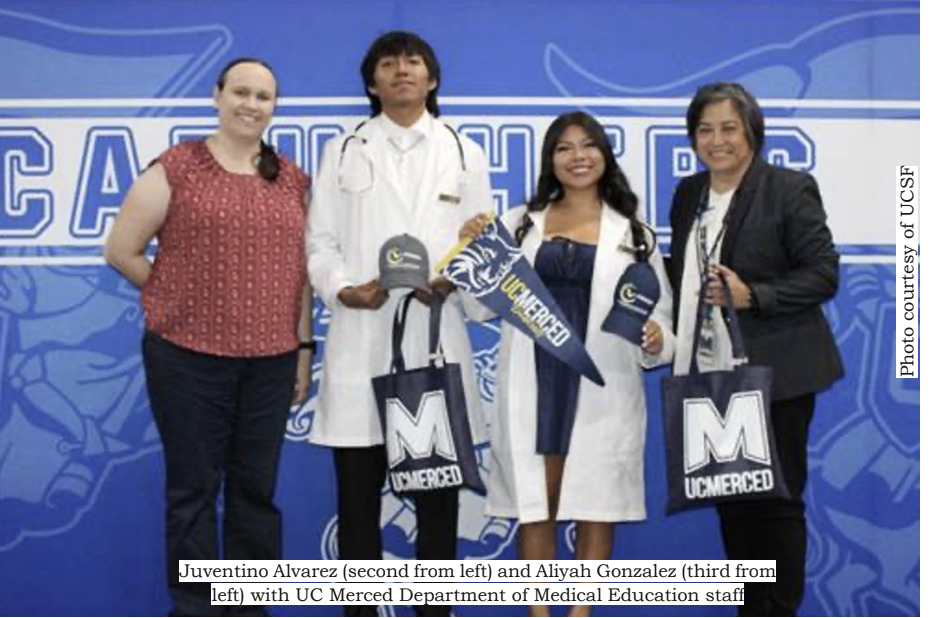
One of these communities is Caruthers, California, the hometown of two students from the class of 2026 who highlight the program’s impact on their lives. Aliyah Gonzalez, a student from Caruthers High School who will be enrolling at UC Merced this fall, noted that mentorship during her five-week Doctors Academy Summer Experience program, which placed her with Adventist Health in Hanford, California, was pivotal. It led her to apply to the SJV PRIME+ program, while just a few years earlier, she had debated whether college was even possible. She highlighted that a medical assistant she connected with during her Doctor’s Academy Summer Experience wrote her letter of recommendation for the program. This brought to light how crucial it is to have mentorship from the larger clinical team, which can impact students’ trajectories.
Additionally, Juventino Alvarez, also from Caruthers High School, was asked about his personal development and the importance of mentorship. Juventino discussed how a fellow student whom he met during his freshman year of high school encouraged him to try new things and join programs like Doctors Academy. He explained how this experience motivated him to pay it forward by mentoring a freshman when he was a senior. When asked about how the program shaped him academically and personally, Juventino focused on the mentoring aspect and his growth in confidence. He shared a meaningful experience with Summer Beeson, MD, his summer program mentor, who wrote a letter of recommendation for the SJV Prime Plus program. Juventino observed Dr. Beeson's deep connection with patients during his shadowing experience, which inspired him and reinforced his interest in medicine.
In 2022, UCSF Fresno became one of the four founding Regional Hubs of Healthcare Opportunity (RHHO) under the statewide California Medicine Scholars Program (CMSP) (see https://californiamedicinescholarsprogram.org/). In Fresno, the program is called CMSP San Joaquin Valley- MedBridge. Now in its fifth cohort, the CMSP SJV-MedBridge program has over 250 scholars enrolled, recruited during their community college enrollment. The first of its kind in the San Joaquin Valley, the program provides early career exposure to medicine for community college students in the service area of the San Joaquin Valley’s eight counties. As enrollment grows, the diverse needs of the program learners also grow. Students are provided mentorship opportunities through the SJV Mentoring to Medicine program, which was launched in summer 2024. The program pays students a $3,000 stipend, provides them with a clinical placement, community-based organization volunteer placement and an opportunity to do research on health disparities affecting their local community; these are all areas that medical schools consider when reviewing applications. UCSF Fresno does not use race, gender, sex, or other protected categories or proxies for protected categories in selecting its program participants.
Mario Garcia, a current student at Reedley College who has participated in both CMSP SJV-MedBridge and SJV Mentoring to Medicine, highlights his experience in both programs as essential to his current trajectory.
“As a Latino student pursuing a career in medicine and health care, I have seen how meaningful mentorship can be. I would encourage educators and community leaders to continue supporting mentorship programs because they can give students the guidance, resources and confidence needed to pursue dreams that may seem impossible to reach. These programs make students feel seen, supported and capable of overcoming any barrier and succeeding in a health care career. More importantly, they inspire the next generation of Latino/a health care professionals for our San Joaquin Valley, who will return to serve and advocate for the communities that helped shape them.”
Core components and best practices of current programming have included:
· Academic enrichment and preparation for health career pathways via cohort-style programs such as Junior Doctors Academy (middle school), Doctors Academy (high school) and California Medicine Scholars Program (CMSP) San Joaquin Valley MedBridge (SJV-MedBridge)
· Intentional longitudinal mentorship programming that integrates engagement opportunities for local medical students, residents, faculty and community organizations; this benefits students’ own professional development while also supporting the local community where students live and study.
· Exposure to clinical environments and health professions via work-based learning opportunities that are age appropriate and accessible, based on the student’s level of education.
· College and career advising, including application support and resources at transitionary points of a student's educational journey.
· Community-building among students navigating similar pathways: Overthree decades of work, programming has evolved from a set of discrete enrichment activities into a more integrated pipeline model emphasizing continuous support , early exposure, and sustained mentorship. We have also expanded partnerships with local schools, community colleges, and universities to strengthen recruitment and alignment. With investment from foundations and gifts, we have aimed to include post-undergraduate support, specifically for those in transitional gap years.
The impact of UCSF Fresno’s diverse support programs is also evident in several areas.
· Student Advancement: A growing number of participants in UCSF Fresno programming have progressed from high school to college, and from college into health professional programs, including medicine, nursing, and allied health fields. While long-term tracking remains an area for continued development, we have seen encouraging trends in persistence and advancement amongst students we have served.
· Representation and Identity: Students frequently report that exposure to mentors who share similar backgrounds is transformative. Seeing physicians and trainees from similar backgrounds has helped students envision themselves in these roles.
· Community Impact: By focusing on students from the San Joaquin Valley, our efforts contribute to a longer-term vision of building a more representative and locally rooted health workforce. Many participants express a desire to return and serve their communities. OHCP has institutionally focused on elevating and engaging individuals who are home grown and significantly more likely to return home to serve their community.
· Institutional Growth: The supported programs have strengthened UCSF Fresno’s role as a regional hub for outreach, mentorship, and workforce development, and deepened partnerships with educational and community organizations. OHCP’s experience in running successful pathway work has led to selection in competitive state and regional grant opportunities in recent years.
Reflections & Lessons Learned
Over time, several key insights have emerged.
The first of these is that longitudinal support matters. Short-term programming can spark interest (workshops, conferences, one-day events, etc), but sustained engagement is critical for persistence and resilience. Students benefit most when support extends across multiple years and transitions (e.g., high school to college), as well as understanding that they can be supported via organizational connections and guidance even after program completion.
Secondly, mentorship is foundational. Relationships with near-peer mentors, faculty, and program staff are often the component with the greatest impact. Mentorship provides not only academic guidance but also encouragement, validation, and navigation of systems that can be difficult without guidance or lived experiences that many of the students lack.
Thirdly, community and belonging are critical. Creating spaces where students feel seen and supported alongside peers with similar experiences via cohort models reduces isolation and strengthens commitment to their goals. We have been able to duplicate these efforts across other new programming initiatives and funding opportunities.
Fourthly, it must be recognized that structural barriers persist. Academic preparation gaps, financial constraints, and limited access to resources continue to shape students’ trajectories, especially when pursuing healthcare careers. Programs must be designed with these realities in mind; they must also recognize that family and community are strong forces that influence decision making and identity for the students we serve. Warm hand-offs to other health pathway partners as learners transition through the pipeline makes students more likely to retain interest and perseverance.
Finally, flexibility is key. The ability to adapt programming, whether in response to student needs or broader disruptions, has been essential to maintaining continuity and relevance. Just like the resilient and adaptable students we serve, our team regularly pivots efforts to meet learners where they are, in order to ensure retention and engagement. During the COVID pandemic, for example, we were forced to modify all program learning to an online model. This has allowed our team to seamlessly integrate more virtual or hybrid offerings such as conferences, guest speakers, mentorship connections, college exposure opportunities, amongst others.
About the Author
Stephanie Huerta Alvarez grew up in the small, rural farm town of Caruthers, California, in Fresno County within the San Joaquin Valley. She is an alumnus of the first UCSF Fresno Doctors Academy cohort at Caruthers High School. In 2016, she joined UCSF Fresno to support pathway development and now oversees the regional campus initiatives as the Manager and Principal Investigator for the Office of Health Career Pathways at UCSF Fresno. As a first-generation student and teen parent, she