A Profile of Hispanics/Latinos in Medical Schools
Last year, Hispanic Outlook inaugurated a new set of lists on Hispanics/Latinos in medical schools, as part of our ongoing commitment to providing readers with concrete, precise data that helps to shed light on the presence of Hispanic/Latino students in the higher education landscape. In these pages, we update and expand these lists, based on the most recent data provided by the Association of American Medical Colleges (AAMC). It is particularly important to follow up on the inclusion of Hispanic/Latino students in medical fields, given that they have been persistently under-represented in this area. The result of low medical school participation is that, although Hispanics/Latinos represent around 20% of the total U.S. population, the total number of Hispanic/Latino physicians is 69,168, representing only 6.7% of all physicians in the country (AAMC, US Physician Data Dashboard, 2024).
Hispanic/Latino Students in Medical Schools: Current Profile
According to the AAMC’s Organizational Characteristics Database, as of June 2026 there were 163 accredited, MD-granting medical schools in the United States. This includes four Puerto Rican medical schools: Ponce Health Sciences University School of Medicine, San Juan Bautista School of Medicine, Universidad Central del Caribe School of Medicine, and the University of Puerto Rico School of Medicine. These Puerto Rican schools naturally have the highest numbers and proportion of Hispanic/Latino students; for this reason, they are excluded from the following analysis, which focuses on the remaining 159 mainland U.S. schools.
Enrollment data by ethnicity for 2025-26 and data on graduates for 2024-25 indicates that:
· There are 6,688 Hispanic/Latino students enrolled in medical schools, out of all 100,723 students at these schools (representing 6.6% of the total). This indicates an almost negligible increase with respect to last year, when Hispanic/Latino enrolment stood at 6,644 students; it also shows a very slight increase since 2021-22, when enrolment for this group stood at 6,190. Thus, growth in Hispanic/Latino enrolment has been extremely slow.
· There are 1,464 Hispanic/Latino medical school graduates, out of a total of 21,590 graduates (representing 6.8%). As with enrollment, the increase in Hispanic/Latino graduates over the past year has been very small (growing by just 95 students, from 1,369 in 2023-24), and has also barely risen since 2021-22, when there were 1,210 Hispanic/Latino graduates.
· Following the same trend since last year, there are slightly fewer Hispanic/Latino men (3,122) enrolled in medical schools than women (3,551). There are also fewer Hispanic/Latino male medical school graduates (693) than female ones (771).
· Among Hispanic/Latino students, Mexican-Americans continue to be by far the largest subgroup of medical students, with 2,041 enrolled (31% of all Hispanics/Latinos), followed by 1,566 Puerto Rican students (23%).
· The majority (90%) of enrolled Hispanic/Latino students are pursuing MD degrees, with very few pursuing combined MD degrees (Bachelors-MD, MD-MBA, MD-MPH, Dental-MD or other combined Masters-MD or MD-PhDs). This is similar to the pattern for medical students overall (regardless of ethnicity), the majority of whom (88%) pursue MD degrees rather than combined MD degrees.
Top 20 Medical Schools with Highest Enrollment and Graduation of Hispanics/Latinos
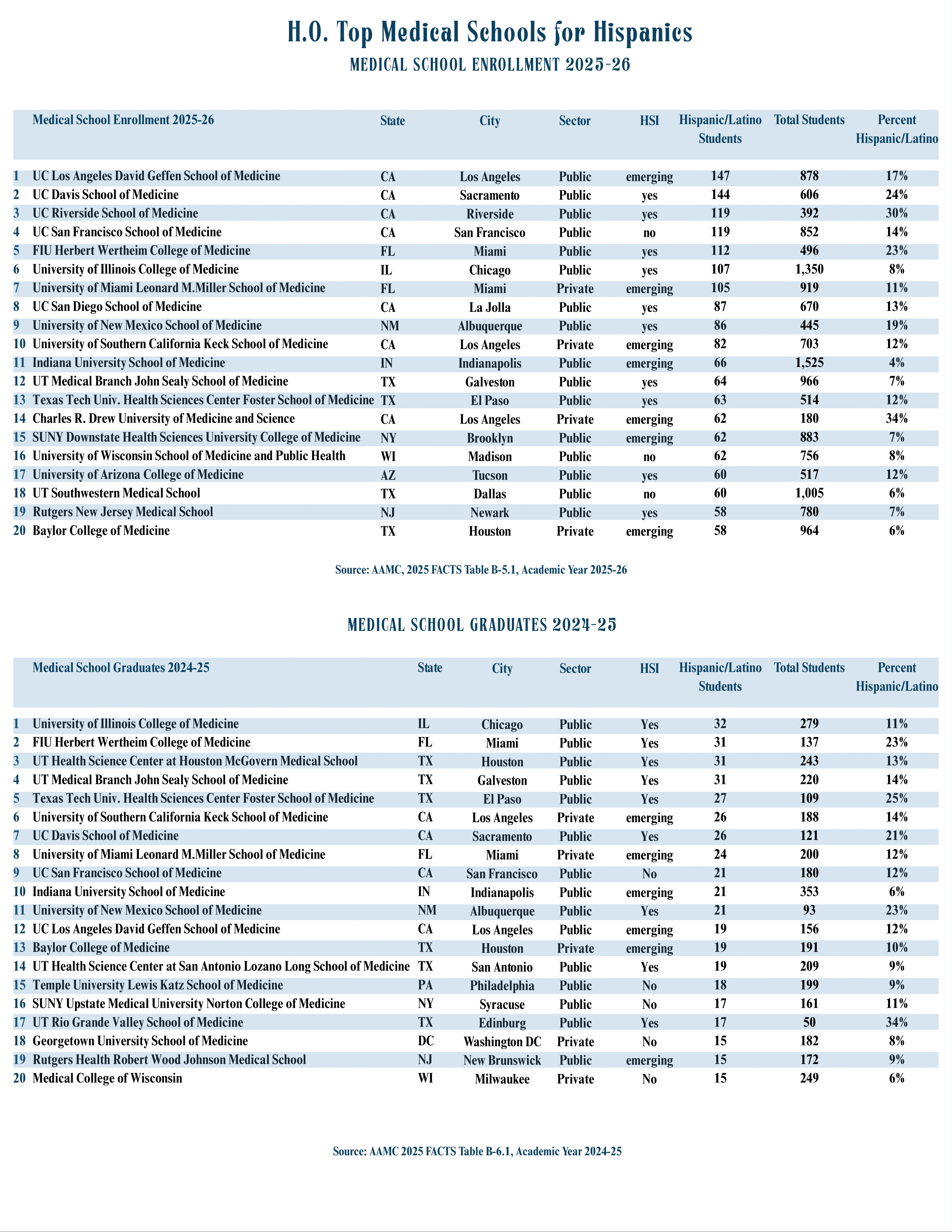
The first two lists below show the top 20 medical schools in the mainland U.S., in terms of highest enrolment and graduation of Hispanic/Latino students, based on the AAMC data cited above. These rankings indicate that:
· One-fourth (26%) of all Hispanic/Latino students enrolled in medical schools are concentrated in these top 20 schools. This indicates that Hispanic/Latino students are more widely spread across a greater number of medical schools than was the case last year, when one-third of all of these students were concentrated in the top 20 institutions. There is a higher concentration among Hispanic/Latino medical school graduates, however: 30% of these are found in the top 20 schools.
· Among the top five Hispanic/Latino-enrolling medical schools, four belong to the University of California system, as they did last year. Indeed, seven of the top 20 institutions are in California; followed by Texas with four schools. Two institutions have risen to the top 20 this year, in terms of Hispanic/Latino enrollment: Charles R. Drew University of Medicine and Science, a private Historically Black Graduate Institution in California, and the University of Wisconsin’s School of Medicine and Public Health.
· Among the top 20 Hispanic/Latino-graduating schools, three of the schools from the University of California system are also present. However, a larger proportion are in Texas (a total of six, four of which belong to the University of Texas system) with three in the top five. Several institutions that were not included last year have now become top Hispanic/Latino-graduating schools: Texas Tech Univ. Health Sciences Center Foster School of Medicine, Temple University Lewis Katz School of Medicine, SUNY Upstate Medical University Norton College of Medicine, Georgetown University School of Medicine, Rutgers Health Robert Wood Johnson Medical School, and the Medical College of Wisconsin.
· Although there is naturally an overlap between the top 20 Hispanic/Latino-enrolling and graduating lists, with many institutions present in both, only Florida International University (FIU)’s Herbert Wertheim College of Medicine is among the top five in both categories.
· Among these top 20 medical schools, Charles R. Drew University of Medicine and Science enrolls the highest proportion of Hispanic/Latino students (34%), while UT Rio Grande Valley School of Medicine has the highest percentage of Hispanic/Latino graduates (34%).
· The majority of these top 20 Hispanic/Latino enrolling and graduating medical schools are public (80% and 75%, respectively). Half of the institutions that these medical schools are attached to have been designated as Hispanic Serving Institutions (HSIs); however, another seven top Hispanic/Latino-enrolling institutions and another six top Hispanic/Latino-graduating institutions are considered “emerging” HSIs. Thus, nearly all of the parent institutions on these lists are either HSIs or on the road to becoming HSIs in the near future.
Hispanic/Latino Enrollment and Graduation at Top-Ranked Medical Schools
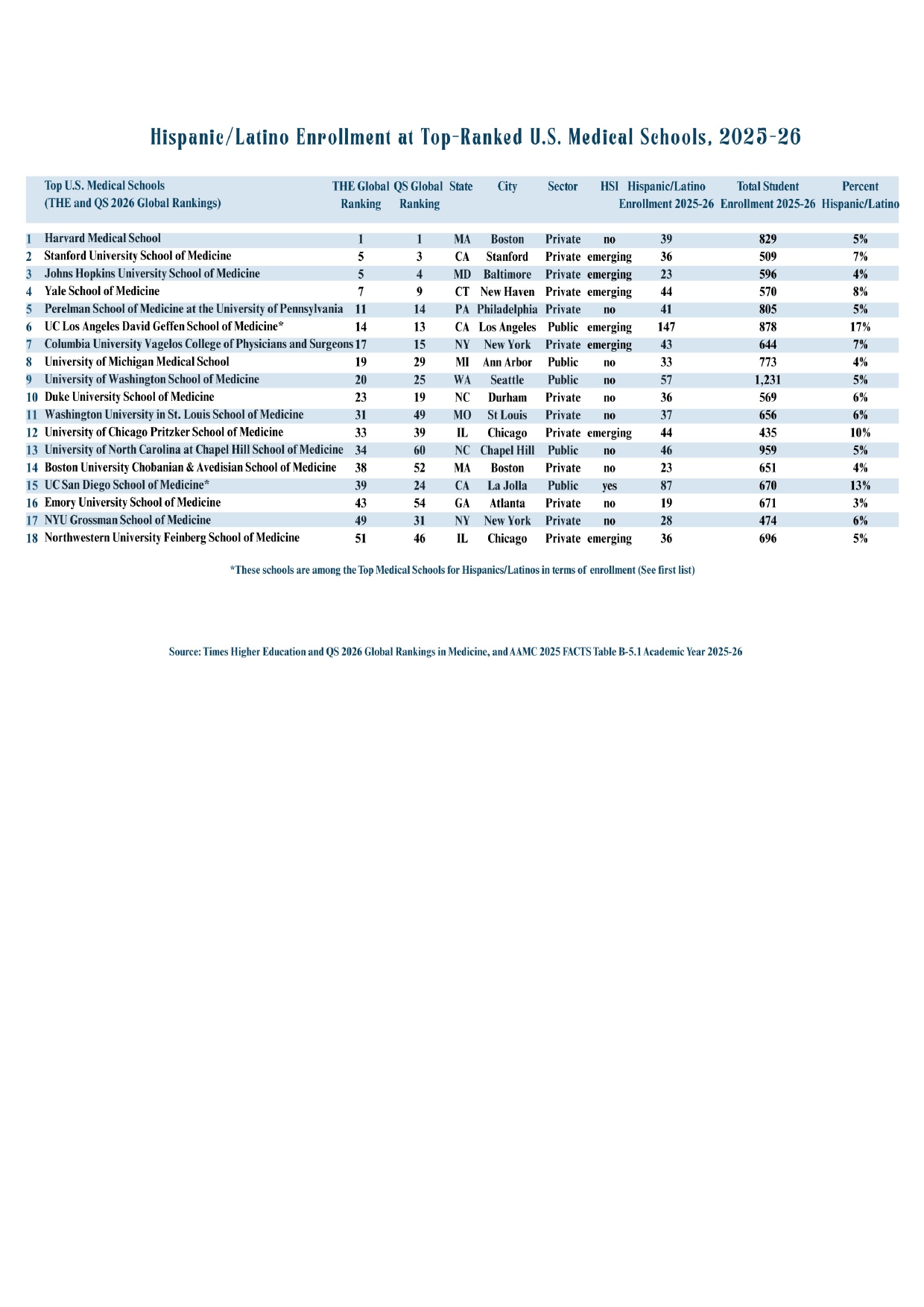
In addition to highlighting the medical schools that enroll and graduate the highest numbers of Hispanic/Latino students, it is also important to gauge the extent to which Hispanic/Latino students are accessing medical schools that reach the highest levels of quality in teaching, practice and research. The final list below provides a snapshot of the presence of Hispanic/Latino students at top-ranked U.S. medical schools, as defined by both the Times Higher Education and the QS global medical school rankings for 2026. These two prestigious rankings have different methodologies, so the U.S. institutions that meet their parameters differ. Nonetheless, both rankings overlap to a large extent, allowing us to formulate a single list that includes the first 18 U.S. institutions mentioned in both rankings (excluding any that are mentioned in only one).
This list, which looks at AAMC 2025-26 enrollment figures at each top-ranked institution, reveals that:
· Whereas most of the top 20 highest Hispanic/Latino-enrolling medical schools (in the first list) are public, and are also either full or emerging HSIs, nearly three-quarters of these globally top-ranked U.S. medical schools are private, and only one belongs to a parent institution that is an established HSI. Nonetheless, it is notable that more than one-third of these medical schools are attached to universities that are emerging HSIs.
· Only two of these top-ranked medical schools have a relatively higher number of Hispanic/Latino students, and are thus included in the top 20 list for Hispanic/Latino enrollment: the UCLA David Geffen School of Medicine, and the UC San Diego School of Medicine. With the exception of these two institutions, all of the other medical schools on this list have very low Hispanic/Latino enrollment, with less than 60 Hispanic/Latino students studying at each one.
· Thus, Hispanic/Latino students make up less than 10% of all students at these top-ranked institutions, except for the two institutions mentioned above and the University of Chicago Pritzker School of Medicine.
In sum, these three lists illustrate the need for greater support and targeted programs to substantially increase Hispanic/Latino students’ enrollment at, and graduation from, medical schools, and to boost their presence at top-ranked medical institutions. A greater number of well-prepared Hispanic/Latino physicians would not only benefit the Hispanic/Latino community – it would also contribute to reducing the overall shortage of medical professionals across the country, and thus to improving healthcare overall.
Sources
AAMC, 2025 FACTS: Enrollment, Graduates, and MD-PhD Data, at: https://www.aamc.org/data-reports/students-residents/data/facts-enrollment-graduates-and-md-phd Specifically the following tables:
Table B-5.1: Total Enrollment by U.S. MD-Granting Medical School and Race/Ethnicity (Alone), Academic Year 2025-2026
Table B-6.1: Total Graduates by U.S. MD-Granting Medical School and Race/Ethnicity (Alone), Academic Year 2024-2025
Table B-15: Total U.S. MD-Granting Medical School Enrollment by Race/Ethnicity (Alone), Gender, and Degree Program, Academic Year 2025-2026
Times Higher Education, Top Medical Schools in the United States 2026, at: https://www.timeshighereducation.com/student/best-universities/best-universities-united-states-medicine-degrees
QS World University Rankings by Subject 2026: Medicine (filtered for the United States), at: https://www.topuniversities.com/university-subject-rankings/medicine?items_per_page=50&countries=us