Rhode Island Latino Arts (RILA) emerged from a simple but important realization: Latino cultural life in Rhode Island was present and active, yet rarely visible in the state’s broader public narrative.
Across communities, culture was shared in many forms—through gatherings, music, food, faith, and local networks that sustained connection and identity. At the same time, there were few spaces where these experiences were documented, interpreted, or widely recognized as part of Rhode Island’s cultural and historical landscape.
The question was not whether history existed, because it did. What was missing was the opportunity to see it, hear it, and recognize it as part of the story of the state.
Founded in 1988, RILA has spent nearly four decades working to ensure that Latino histories, arts, and cultures are not only preserved, but experienced as part of public life. Its mission—to promote, encourage, and preserve Latino art, history, heritage, and cultures—has remained steady, even as the ways of carrying that work forward have continued to evolve.
At the center of RILA’s approach is oral history.
Through the Nuestras Raíces Oral History Project, the organization has gathered stories from Latino residents across Rhode Island—stories of migration, work, family, and community life. These are not treated as static records meant only for archival storage, but as points of departure. An oral history may begin as a recorded interview, but it often continues into other forms.
It may become a theater production, as in La Broa’ (Broad Street), developed from decades of conversations about life along one of Providence’s most active corridors. It may take the form of visual art, where portraits and installations invite reflection on memory and presence. It may guide a neighborhood tour, where participants encounter histories embedded in everyday spaces—storefronts, parks, and sidewalks that carry layers of meaning often overlooked.
RILA’s work moves between disciplines without separating them. Art becomes a way of interpreting history, and history becomes a source for creative expression. Together, they create entry points for the public to engage with stories that might otherwise remain unseen.
This approach extends into education, particularly for young people in urban schools across Rhode Island. Through bilingual theater programs, storytelling workshops, and arts-based learning, students are invited to see themselves not only as participants in history, but as contributors to it. They learn to listen, to document, and to translate lived experience into creative work.
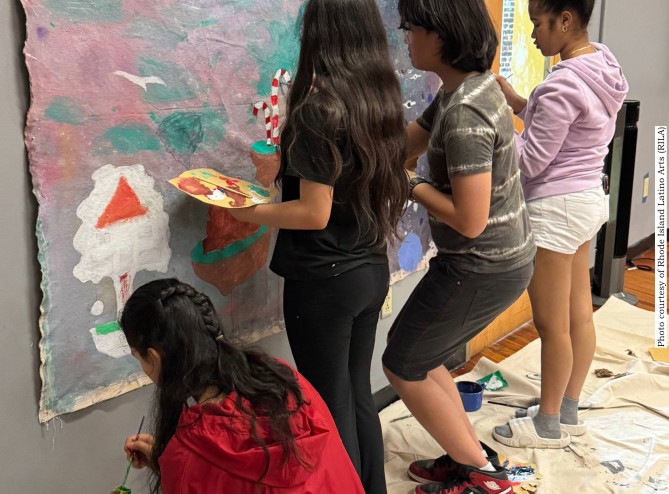
Programs like the Rhode Island Latino Books Award further support this connection by encouraging reading that reflects Latino cultures while also inviting broader audiences to engage with those narratives. The goal is not only representation, but a deeper understanding across classrooms, families, and communities.
Much of this work takes place outside traditional cultural spaces. Each summer, Teatro en El Verano brings performances to parks and neighborhoods across the state, where audiences gather in spaces they already know. The decision to perform outdoors is not simply about access—it is about context, allowing stories to return to the communities that shaped them.
Other initiatives, such as Barrio Tours and El Museo del Barrio, continue this approach by reimagining how a city can be experienced. These projects invite participants to move through Providence with attention to histories that exist in plain sight but are not always named. A neighborhood becomes more than a location; it becomes a layered record of cultural presence and change.
Over time, RILA has also become a place where materials are entrusted. Families have shared photographs, recordings, documents, and personal objects—items that hold meaning beyond their physical form. Together, these contributions have grown into a community archive that continues to evolve as new stories are added and others are revisited.
The archive does not exist separately from public life. It informs exhibitions, performances, and educational programs, ensuring that these materials remain active and accessible.
As RILA approaches its 40th anniversary, the organization is preparing for a new phase of this work. Plans are underway to establish a larger, more visible space in downtown Providence—La Casa de Arte y Cultura. The vision is not simply to house programs, but to bring together the different strands of RILA’s work in one place: a gallery, areas for storytelling and performance, and a space where the archive can be activated through public engagement.
The intention is to create an environment where something is always unfolding. A visitor might encounter an exhibition, a rehearsal, a conversation, or an unexpected moment of connection—an experience that reflects a long-standing belief that culture is not something observed at a distance, but something lived and shared.
The impact of this work is often quiet, but lasting. It can be seen in the individual who hears a story that reflects their own experience, in the student who begins to ask questions about their family’s history, or in the audience member who leaves with a different understanding of the city around them.
Over time, these moments accumulate, contributing to a broader recognition that Latino histories are not recent additions or isolated narratives, but part of the fabric of Rhode Island itself. Making that visible—through art, storytelling, and public engagement—has been at the core of RILA’s work from the beginning, and continues to shape what comes next.
About the author
Marta V. Martínez, PhD is the Executive Director and Founder of Rhode Island Latino Arts (RILA). A writer and cultural leader, she has dedicated nearly four decades to advancing Latino arts, oral history, and community-based cultural initiatives across Rhode Island.