When Evelina Torres first arrived at La Casita Cultural Center as an undergraduate student at Syracuse University, she was looking for a meaningful community placement to fulfill requirements for her dual major in Citizenship & Civic Engagement and Political Science at The Maxwell School.
What she found was a community that would help shape her academic, professional, and personal journey.
Beginning in the fall of 2022, Evelina volunteered in La Casita’s youth programs serving Latino families in Syracuse’s West Side. Over time, she developed close relationships with the youth participating in the programs and with their families, eventually becoming involved in the center’s monthly women’s luncheons and community dialogues.
As her role evolved, Evelina began developing her own civics education initiative designed to empower community voices and encourage civic participation. Her experience at La Casita ultimately inspired her award-winning thesis, “Testimonios: Methodologies and Practice in Latina Political Civic Engagement,” which explored Latina activist theory and the experiences of women advocating for social justice in Syracuse.
Supported by faculty mentors, La Casita staff, and community participants who contributed to focus groups and conversations, Evelina later presented her research, “Relationships between Social Barriers and Civic Engagement,” at the 2025 Midwest Political Science Association Conference in Chicago.
“The experience was amazing,” Evelina reflected during her final year at Syracuse University. “I never thought I would be able to present at one of the largest Political Science conferences in the country, especially on a topic that is so close to my heart. I am so grateful for La Casita’s community and staff and my faculty mentor Steven White, who have all supported me on this research journey."
Evelina’s story reflects a broader educational model developed through the Office of Cultural Engagement for the Hispanic Community (OCE), the Syracuse University unit that oversees La Casita Cultural Center and collaborates closely with Punto de Contacto–Point of Contact (POC), a long-standing arts and humanities organization operating in residence at Syracuse University.
Established in 2012, OCE was created to connect Syracuse University students with the broader Latino communities of Central New York through co-curricular projects, civic engagement, research, arts programming, and cultural exchange. La Casita, founded in 2011, serves as a bridge between the University and the community through community-based programs, arts education, cultural heritage preservation, public events, and interdisciplinary collaborations. Point of Contact, an independent nonprofit organization in residence at Syracuse University since 1975, fosters dialogue across cultures through contemporary visual arts, literature, poetry, and humanities programming focused on Latin America and the Latino experience.
Together, these units foster real-world opportunities for experiential learning.

Each year, nearly 200 students participate in internships, independent studies, research projects, practicums, and volunteer initiatives connected to disciplines ranging from public health and social work to museum studies, communications, architecture, policy studies, non-profit management, education, computer science, film, creative writing, and the arts.
What makes these experiences especially meaningful is that students often arrive believing they are coming to serve the community, only to discover that the community itself becomes an essential part of their own education.
That process unfolds through relationships built over time and grounded in trust.
At La Casita, children participating in afterschool STEM programs recently learned how to design and build their own websites through workshops led by mentors from the Syracuse University Information Technology Experience (SUITE), a collaborative initiative between Syracuse University’s iSchool and the Shaw Center focused on digital literacy and community engagement. For university students serving as mentors, the experience extends beyond technology instruction. It becomes an opportunity to develop communication, leadership, and collaborative problem-solving skills while working directly with local youth.
For graduate student Diana Varo Lucero from the Newhouse School, community engagement became central to her work as a multimedia storyteller. While volunteering in La Casita’s bilingual literacy and women’s programs, Diana developed relationships with community members that later informed her master’s thesis project, Rever, a documentary and companion zine exploring the forgotten dreams, sacrifices, and resilience of immigrant families.
“I think that to create impact, we must actively become involved with our communities,” Diana explained. “La Casita has given me the space to learn and become involved.”
Her project emerged not simply from observation, but from participation, dialogue, and trust developed through sustained engagement with the community.
Experiential learning also extends into visual arts and museum studies. Over the past several years, Point of Contact exhibitions have served as hands-on learning environments for graduate students in museum studies, collections management, and exhibition preparation. Students collaborate directly with internationally recognized artists, curators, and cultural institutions while helping produce major exhibitions focused on Latin American and Latino contemporary art.
Projects such as The Border is a Weapon, developed in collaboration with the Laredo Center for the Arts and a collective of artists from the U.S.–Mexico border region, connected students not only to museum practice but also to broader conversations surrounding migration, identity, policy, and social justice. In 2024, students worked closely with curator Matias Roth during the installation of Libro de Artista, an exhibition organized in partnership with Argentina’s Museo Nacional de Bellas Artes and presented at Syracuse University as the collection’s first major showing in the United States.
At La Casita, exhibitions become collaborative community spaces where artists, students, youth, and families create together. In recent years, artists Cayetano Valenzuela and Manuel Matías worked directly with Syracuse University students to facilitate youth arts workshops whose resulting works became part of the exhibitions themselves.
The center has also become an important site for students in public health, social work, art therapy, and medical education. Students from Syracuse University and SUNY Upstate Medical University complete internships and practicum experiences that integrate community wellness, cultural competency, creative expression, and public health outreach.
For many students, these experiences become transformative both professionally and personally.
“La Casita has become a safe haven for those of us who have left our native countries,” explained Paola Méndez Soto, a recent graduate from Syracuse University´s Museum Studies program, who later curated Corpórea, an exhibition featuring artwork created through La Casita’s Art as Mindfulness program. “Hearing the stories shared within this community inspires me to seek out new ways to make the art world more accessible and inclusive for all.”
As La Casita approaches its fifteenth anniversary and Point of Contact reflects on fifty years of artistic and cultural programming, both organizations continue to demonstrate how culturally engaged community spaces can strengthen higher education by connecting academic learning to lived experience, creative practice, and civic responsibility.
At a moment when universities across the country are emphasizing experiential learning and student success, these programs offer powerful evidence that education does not happen only in classrooms.
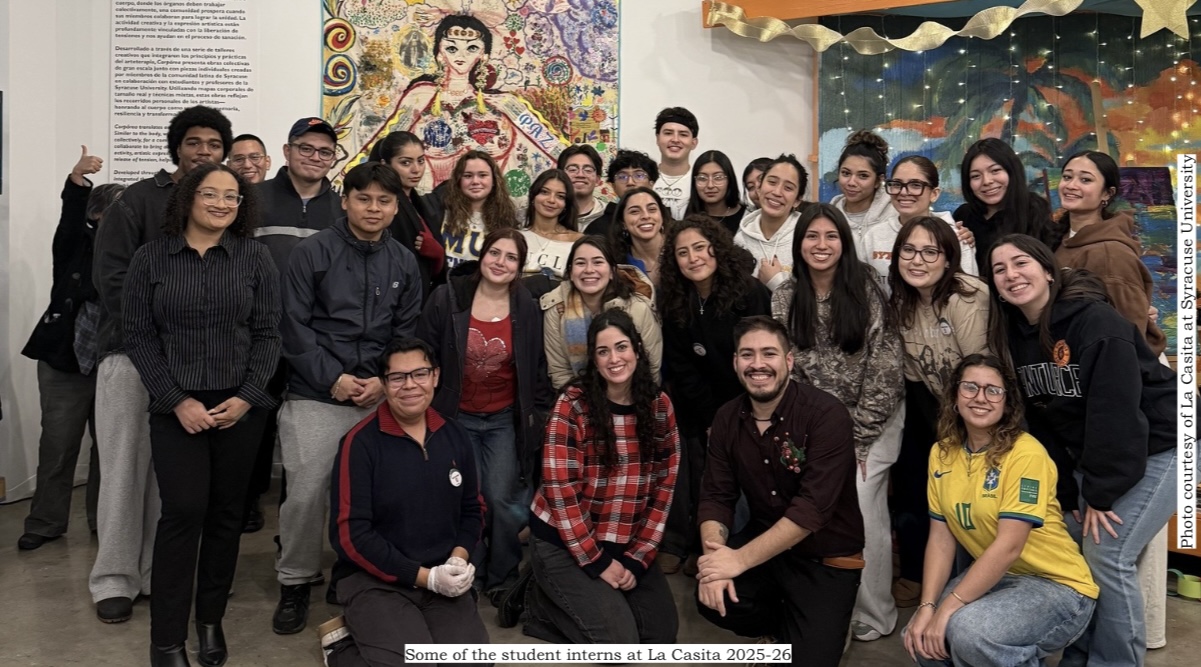
As colleges and universities continue to seek effective strategies for student success, retention, and career readiness, culturally grounded community-engagement programs offer important lessons. Experiential learning in Latino arts and cultural settings transforms cultural identity into an academic asset. These spaces foster belonging, affirm students’ lived experiences, and connect classroom learning to meaningful community impact. In the process, students develop not only professional competencies but also confidence, purpose, and a deeper understanding of their role as engaged citizens and future leaders.
Sometimes, the most meaningful learning begins when students enter a community believing they are there to help, only to discover that the community itself is helping shape who they become.
About the author
Collaborators in this article included Bennie Guzmán, Programming Coordinator at La Casita and a recent graduate from the master’s program in Creative Art Therapy at SU, and Alexander Paredes, Administrator of the Office of Cultural Engagement for the Hispanic Community, a graduate student in Public Administration at SU.
Tere Paniagua is Executive Director of the Office of Cultural Engagement for the Hispanic Community at Syracuse University, where she leads La Casita Cultural Center and Punto de Contacto/Point of Contact, two university-sponsored arts and cultural centers. With more than two decades of experience in nonprofit and university leadership, she develops programs that connect higher education, the arts, and community engagement. Paniagua is committed to fostering cross-cultural dialogue, experiential learning, and community partnerships that amplify Latino voices in Central New York. She also serves on the Board of Trustees of WCNY/PBS.