In the current global context, driven by rapid technological innovation as well as by pressing issues such as climate change, the search for sustainable sources of energy, the spread of new diseases and the need for an increasing number of healthcare professionals, among others, the need for professionals in STEM fields has grown substantially. The term “STEM” broadly encompasses Science, Technology, Engineering and Mathematics, including medical fields, environmental studies and other subjects that are strongly anchored in these four areas. Professionals in STEM fields are generally in high demand, and graduate-level studies in these areas tend to be well remunerated. Thus, STEM studies provide a solid career pathway, and higher education institutions across the country have increased their STEM-related program offerings and encouraged broader access to them, especially among under-represented groups.
Given the ongoing concern over under-representation of Hispanics/Latinos in graduate studies and in STEM fields, in May 2022 Hispanic Outlook presented an account of the number of STEM graduate degrees conferred to Hispanic/Latino students, using national IPEDS (Integrated Postsecondary Education Data System) data from 2019-20, the latest available at that time. In these pages, we re-visit this topic, using the most recent IPEDS data (from 2023-24) to provide a fresh, detailed look at the number of graduate degrees – the sum of all Master’s and Doctor’s degrees - obtained by Hispanic/Latino students in nine STEM-related areas of study (as defined by IPEDS). We also compare these new figures to those reported in our 2022 article, to give us an idea of the changes that have taken place since then.
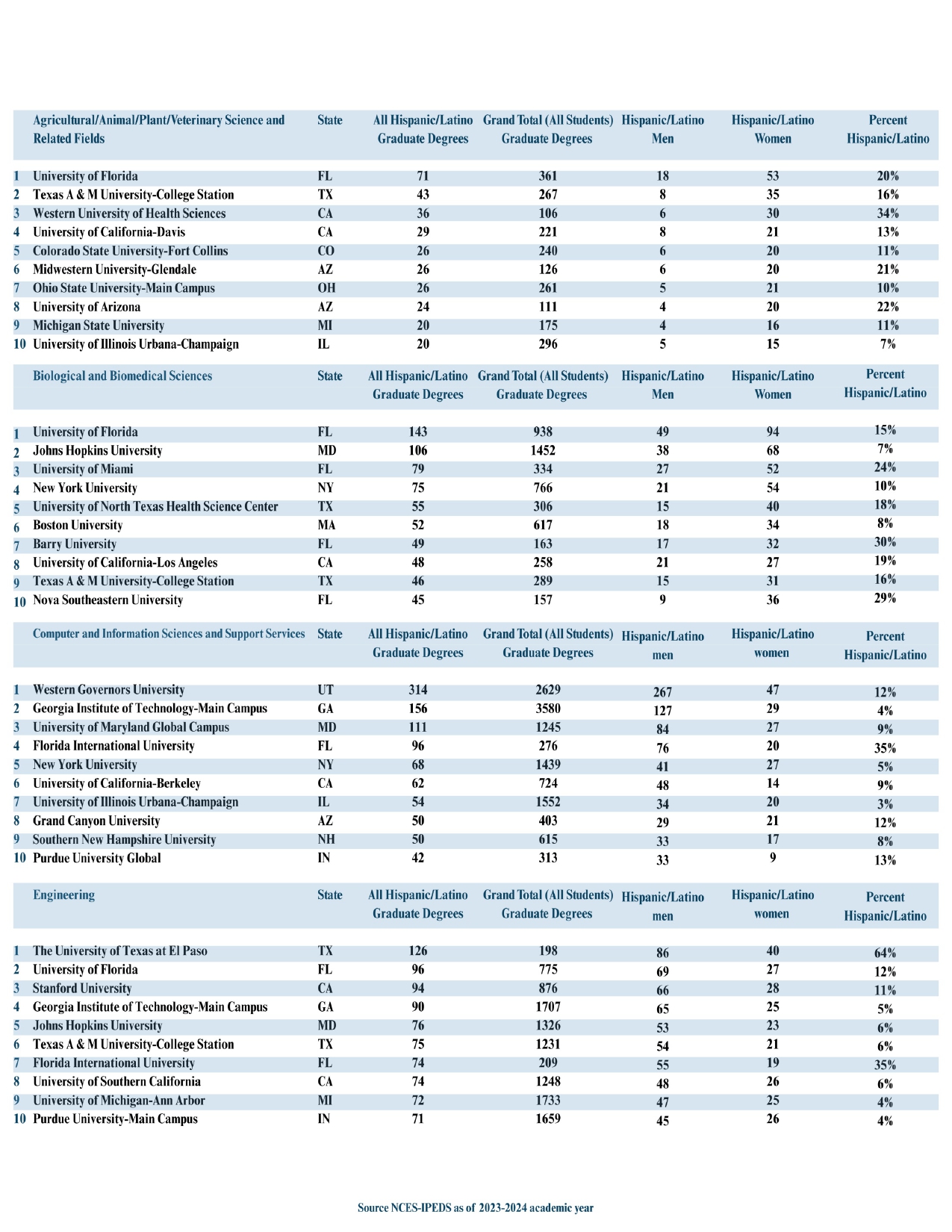
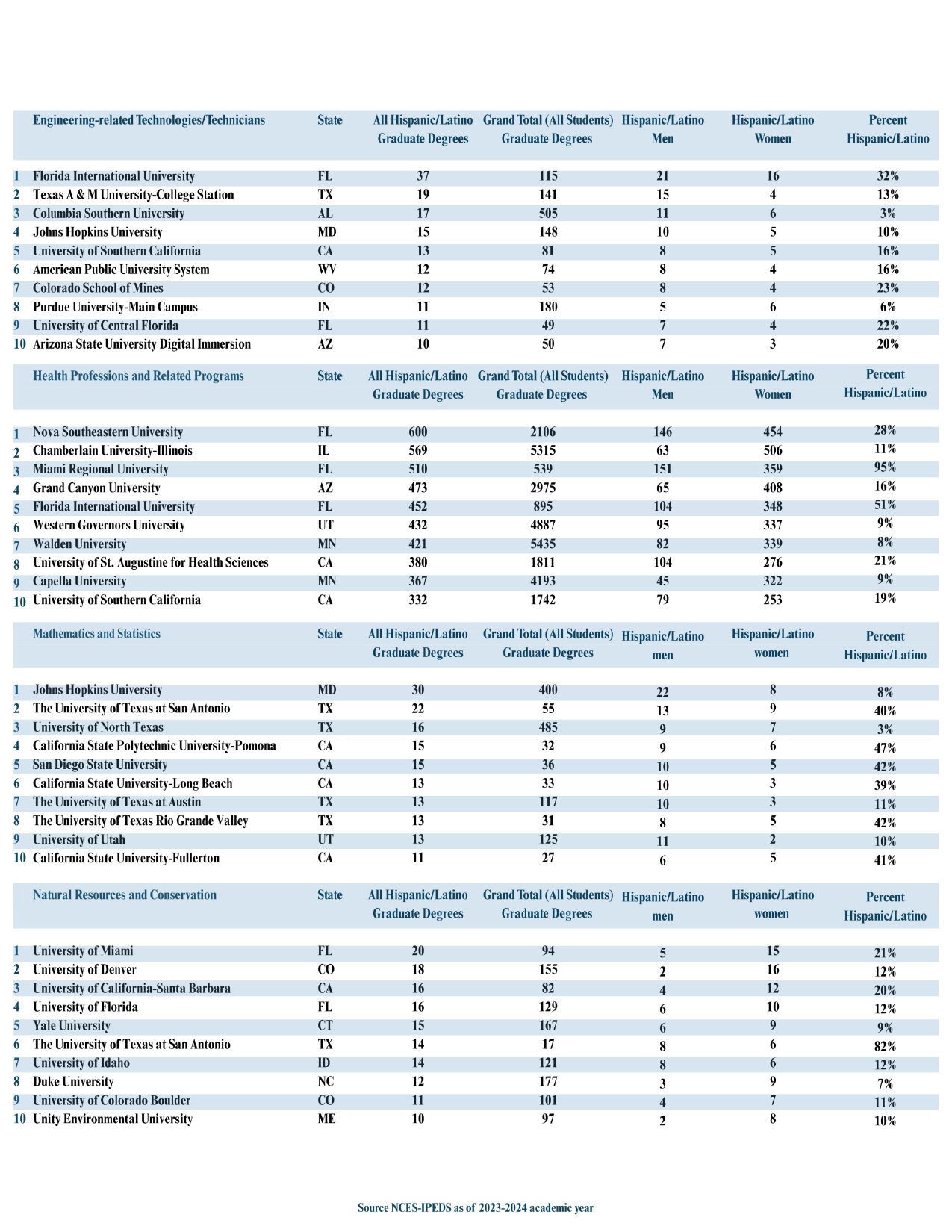
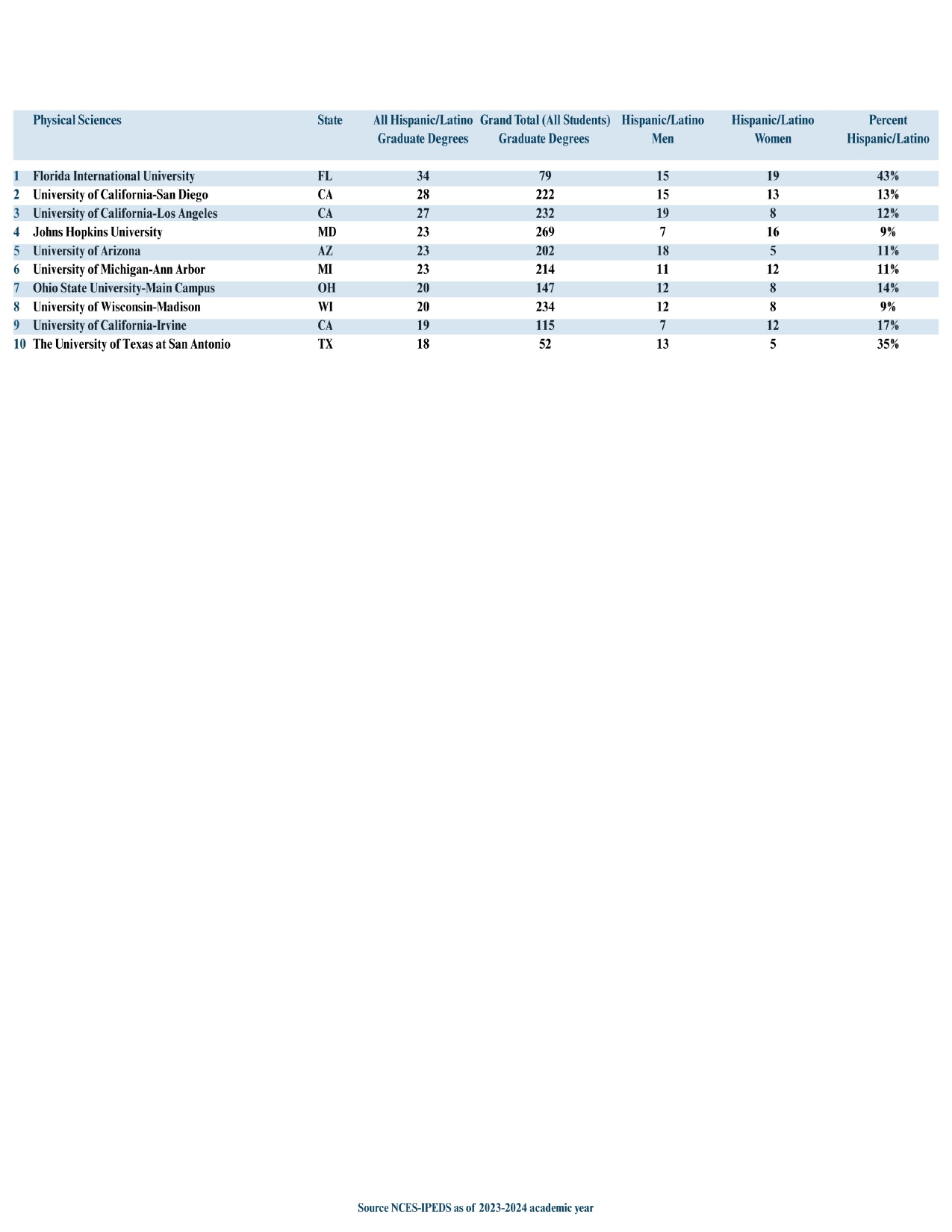
This data allows us to identify those institutions that serve the largest number of Hispanic/Latino students in each STEM-related field. Thus, each of the following lists recognizes the top 10 institutions for each field, in terms of the number of graduate degrees awarded to Hispanic/Latino students.
Hispanics/Latinos in STEM Studies: Overall Landscape
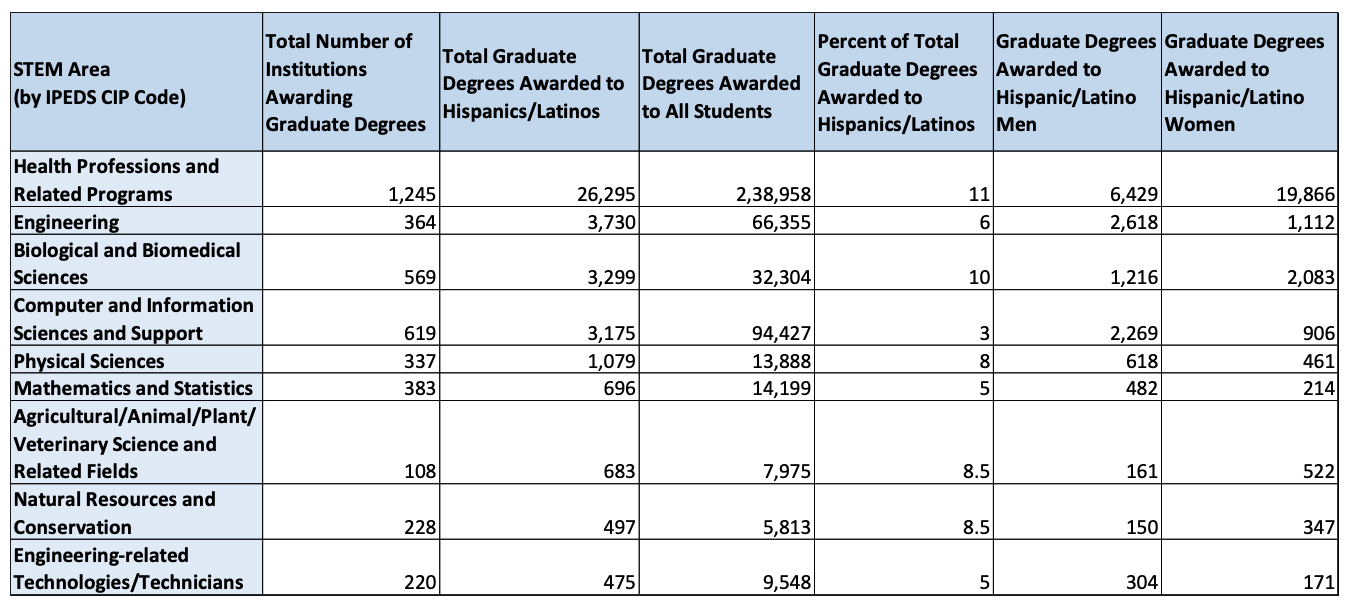
This analysis is based on nine broad academic disciplines defined by IPEDS’ Classification of Instructional Programs (CIP). In the 2023-24 academic year:
· The area with by far the highest number of overall graduate degrees awarded was Health Professions and Related Programs, which encompasses 31 fields, including Medicine, Dentistry, Rehabilitation, Allied Health, Mental and Social Health, Laboratory Science, Optometry, Pharmacy, Nutrition, and all areas of Nursing. This area also accounted for two-thirds (66%) of all STEM-related graduate degrees awarded to Hispanic/Latino students. It is notable that nearly 76% of Hispanic/Latino graduate degree recipients in Health Professions were women; this could be due to the general preponderance of women in Nursing professions, but a more detailed analysis of this area is needed to explain this phenomenon.
· The next three STEM-related areas conferring large numbers of graduate degrees overall, and among Hispanics/Latinos (with more than 3,000 degrees awarded in each), were Engineering, Biological and Biomedical Sciences, and Computer and Information Sciences. Together, these three areas accounted for 75% of all Hispanic/Latino graduate degrees in the eight remaining STEM-related areas (leaving out Health Professions).
· A small percentage of total graduate degrees in all nine STEM-related areas were conferred to Hispanic/Latino students, highlighting their continued under-representation and the work that still needs to be done to boost their presence in higher-level STEM professions. The proportion of Hispanic/Latino graduate degrees was slightly higher in Health Professions and Related Programs (11%) and in Biological and Biomedical Sciences (10%), and lowest in Computer and Information Sciences and Support (only 3%).
· In addition to Health Professions, Hispanic/Latina women have a far greater presence than Hispanic/Latino men in Biological and Biomedical Sciences (with 63% of all Hispanic/Latino graduate degrees awarded to them), Agricultural/Animal/Plant/Veterinary Science and Related Fields (76%), and Natural Resources and Conservation (70%), indicating that men need to be more actively recruited for these areas. At the same time, women still need higher representation in the fields of Engineering, Engineering Related Technologies and Technicians, Computer and Information Sciences, and Mathematics and Statistics, where between 29% and 36% of all graduate degrees conferred to Hispanics/Latinos went to women. The Physical Sciences were the only area with a relatively more even gender distribution (43% women and 57% men).
 A comparison of the 2023-24 data for the top 10 graduate degree-granting institutions in each STEM area with that of 2019-20 (presented in our May 2022 issue) reveals that:
· There has been an increase in the number of graduate degrees granted to Hispanic/Latino students, across all STEM areas (Engineering-related Technologies/Technicians is not included in this comparison, as it was not analyzed in 2019-20). This growth was most notable in the area of Computer and Information Sciences, where Hispanic/Latino graduate degrees nearly doubled, from 580 at all top 10 institutions in 2019-20 to 1,003 in 2023-24 (while the growth in overall graduate degrees was more moderate). Nonetheless, the effects of the Covid19 pandemic must be taken into account when looking at changes over this period of time, and more detailed analysis of each year is needed to come to more concrete conclusions about overall growth.
· Although the absolute numbers of graduate degrees conferred to Hispanic/Latino students have increased since 2020, they still remain relatively low (less than 1,000 at the total of top 10 institutions for each area, except for Health Professions). The graph below illustrates the differences in numbers of Hispanic/Latino graduate degrees between 2019-20 and 2023-24 for all areas except for Health Professions and Related Programs, given the vast difference in range for this area, which increased from 3,404 to 4,536 over this four-year period.
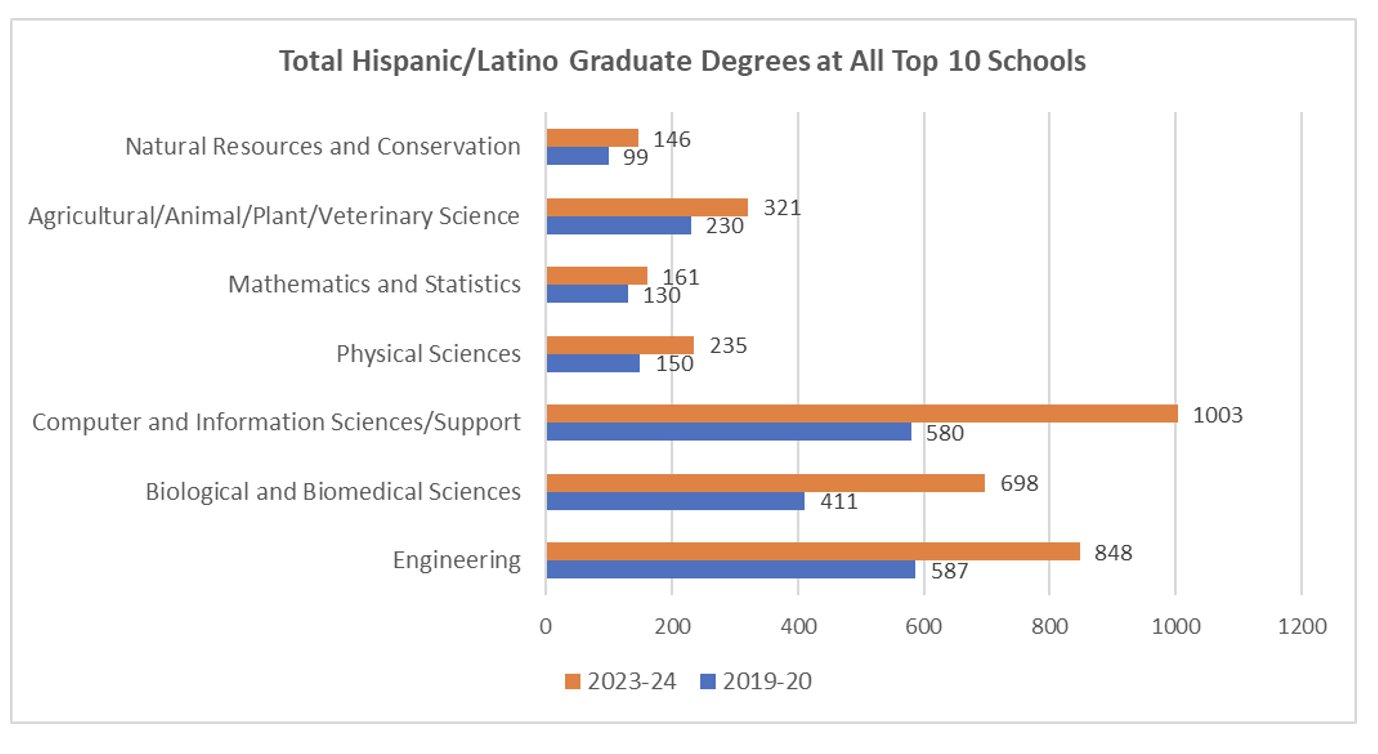
Top Hispanic/Latino Graduate Degree-Granting Institutions, by STEM Area
In seven of the nine STEM areas analyzed, the majority of top 10 Hispanic/Latino graduate degree-granting schools are public. In Biological and Biomedical Sciences, as well as in Health Professions and Related Programs, the majority are private (not-for-profit and for-profit).
Some institutions stand out for granting high numbers of graduate degrees to Hispanic/Latino students across several of these key STEM fields. The following institutions appear in four or more of these top ten lists:
· Johns Hopkins University, which only appeared in two top 10 lists in 2019-20, now appears in five of these lists. It ranks 1st place in Mathematics and Statistics, 2nd place in Biological and Biomedical Sciences, 4th place in Physical Sciences and in Engineering-related Technologies/Technicians, and 5th place in Engineering.
· Florida International University, ranked in four lists in 2019-20, is now present in five lists. It comes in 1st place in Physical Sciences and in Engineering-related Technologies/Technicians, 4th place in Computer and Information Sciences, 5th place in Health Professions and Related Services, and 7th place in Engineering.
· Texas A & M University - College Station, which appeared in five of these lists in 2019-20, continues to be present in four of them. It ranks in 2nd place in Agricultural/Animal/Plant/Veterinary Sciences and in Engineering-related Technologies/Technicians, 6th in Engineering, and 9th in Biological and Biomedical Sciences.
· The University of Florida was present in three lists in 2019-20, and now appears in four. It ranks 1st in Agricultural/Animal/Plant/Veterinary Sciences and in Biological and Biomedical Sciences, 3rd in Engineering, and 4th in Natural Resources and Conservation.
At some of the institutions listed across these STEM areas, Hispanic/Latino students constitute a large proportion of all students obtaining graduate degrees. Schools with more than a third of all graduate degrees granted to Hispanic/Latino students are:
· Miami Regional University, with 95% in Health Professions and Related Programs
· Florida International University, with 51% in Health Professions and Related Programs, 43% in Physical Sciences, 35% in Computer and Information Sciences, and 35% in Engineering
· The University of Texas at San Antonio, with 82% in Natural Resources and Conservation, 40% in Mathematics and Statistics and 35% in Physical Sciences
· The University of Texas at El Paso, with 64% in Engineering
· California State Polytechnic University – Pomona, with 47% in Mathematics and Statistics
· San Diego State University, with 42% in Mathematics and Statistics
· The University of Texas Rio Grande Valley, with 42% in Mathematics and Statistics
· California State University Fullerton, with 41% in Mathematics and Statistics
· California State University Long Beach, with 39% in Mathematics and Statistics
· Western University of Health Sciences, with 34% in Agricultural/Animal/Plant/Veterinary Sciences
In most of these STEM areas, a greater number of Master’s degrees were awarded to Hispanic/Latino students than Doctor’s degrees (reflecting the overall greater proportion of Master’s degrees awarded to all students at these institutions). The exceptions are Agricultural/Animal/Plant/Veterinary Sciences, where more Doctor’s degrees than Master’s degrees were awarded (both in general, and specifically to Hispanic/Latino students), and Physical Sciences, where a fairly even proportion of both types of degrees were conferred.