Community colleges play a role in affordable, higher education and workforce opportunities for Hispanic/Latino students. Rankings IPEDS data highlight top institutions, while evolving classifications and growth of bachelor’s programs reveal shifting enrollment patterns and increasing importance of four-year community colleges.
Community colleges are essential for the advancement of hundreds of thousands of students across the country, due to their affordability, emphasis on workforce development, flexibility, and holistic support services for diverse groups of learners. These institutions are particularly important for the large proportion of Hispanic/Latino students who begin their higher education studies here, accessing wider opportunities from this base. Thus, Hispanic Outlook emphasises community colleges’ invaluable support every year, by recognizing those that serve the largest number of Hispanic/Latino students (measured through enrollment and degrees granted). In order to identify these top 50 community colleges, we draw upon the latest data (Fall 2024 for enrollment, and 2023-24 academic year for degrees granted) provided by the Integrated Postsecondary Education Data System (IPEDS), a part of the National Center for Education Statistics (NCES).
For the past few years, Hispanic Outlook’s ranking of Top Community Colleges for Hispanics has recognized the growing trend of baccalaureate-granting community colleges, in addition to purely associate degree-granting colleges. Indeed, the NCES IPEDS Carnegie classifications were changed last year to reflect the new ways in which higher education institutions are configured, with more clearly defined categories.
Thus, we present two separate sets of lists: one set for “traditional” 2-year institutions with associate’s degrees as the highest degree granted, and the other set for community colleges that offer bachelor’s degrees as well. This second set is separate because IPEDS defines them as 4-year institutions; nonetheless, they are still considered community colleges (and are thus differentiated from conventional 4-year universities) because they have Carnegie classifications that include “Mixed Associate Large”, “Mixed Associate Medium”, “Mixed Associate Small”, “Professions Focused Associate Medium/Large”, “Professions Focused Associate Small”, “Mixed Associate/Baccalaureate”, and “Professions Focused Associate/Baccalaureate”. Some are also classified as “Special Focus” institutions. The Associate/Baccalaureate and Special Focus categories was carefully examined to ensure that each institution mentioned is indeed primarily a Community College.
Top 50 Community Colleges: Enrollment
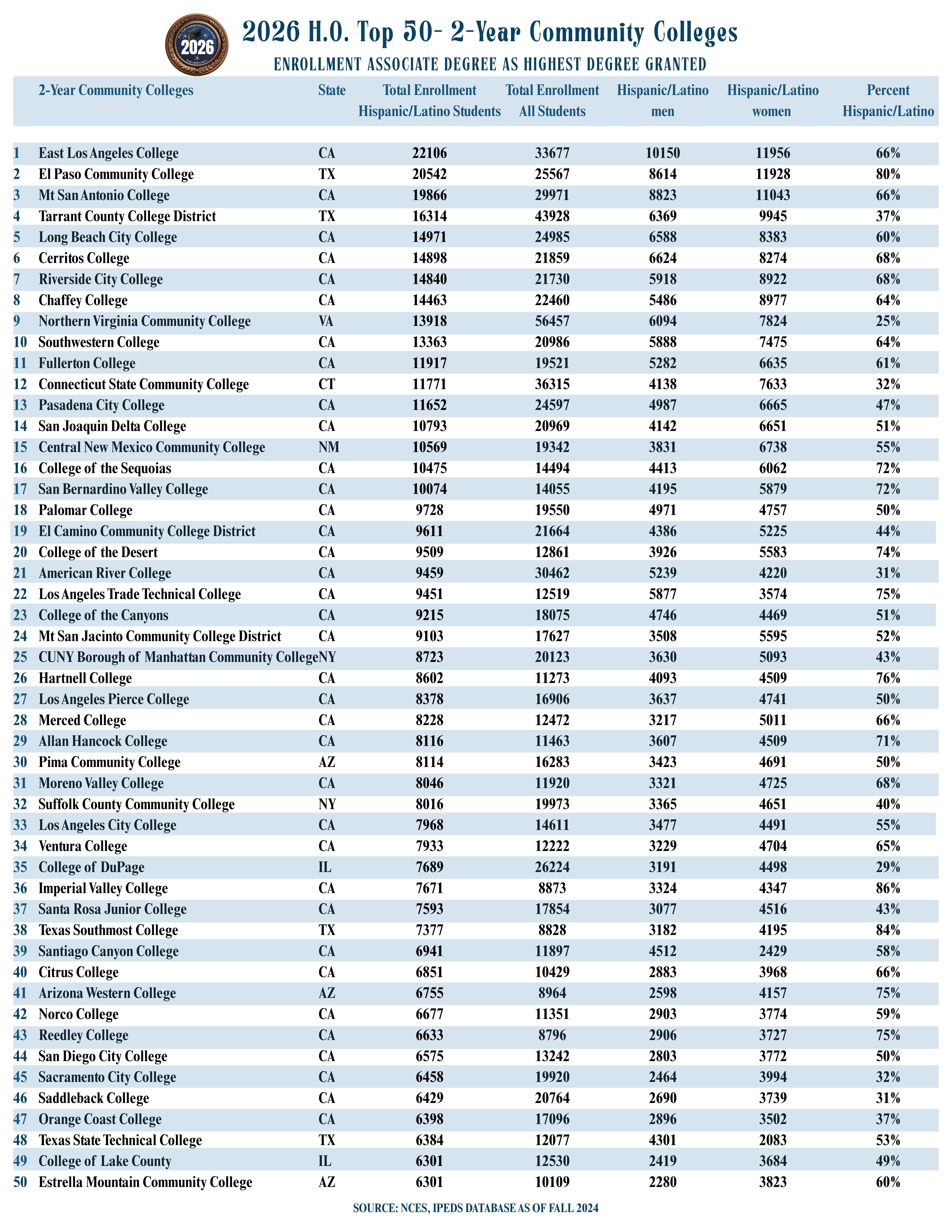
Two-year Community Colleges (with Associate’s Degrees as Highest Degrees Granted)
- In Fall 2024, all top 50 two-year community colleges enrolled half a million (499,369) Hispanic/Latino students, a slight decrease of 1,990 from Fall 2023. It is notable that the growth trend of Hispanic/Latino enrollment over the past few years (increases of 15,000 students between Fall 2021 and Fall 2022, and of nearly 27,000 students between Fall 2022 and Fall 2023) has stopped over the past year, and in fact declined for these two-year colleges. This may be explained by the fact that 10 large community colleges that were previously on this list are no longer included here, as they are now classified as four-year institutions - just three of these enroll more than 10,000 Hispanic/Latino students each.
- All top 50 two-year community colleges are public institutions. With regard to their classification, more than half (29) are “Large Mixed Associate” institutions, 14 are “Medium Mixed Associate” colleges, 6 are “Professions-Focused Large/Medium Associate” colleges, and one is a “Special Focus – Applied and Career Studies” institution.
- The majority of the colleges on this list are in California (36). The remaining colleges are in Texas (4), Arizona (3), New York (2), Illinois (2), Connecticut, New Mexico and Virginia (one each).
- The top three institutions - East Los Angeles College, El Paso Community College and Mt. San Antonio College - each enrolled more than 19,000 Hispanic/Latino students. Enrollment at the top ten institutions accounted for a third (33%) of total Hispanic/Latino enrollment at all top 50 colleges, indicating a high concentration of Hispanic/Latino students in a relatively small number of two-year community colleges.
- The colleges with the highest percentage of Hispanics/Latinos as a proportion of total enrollment were Imperial Valley College in California (86%), Texas Southmost College (84%) and El Paso Community College (80%).
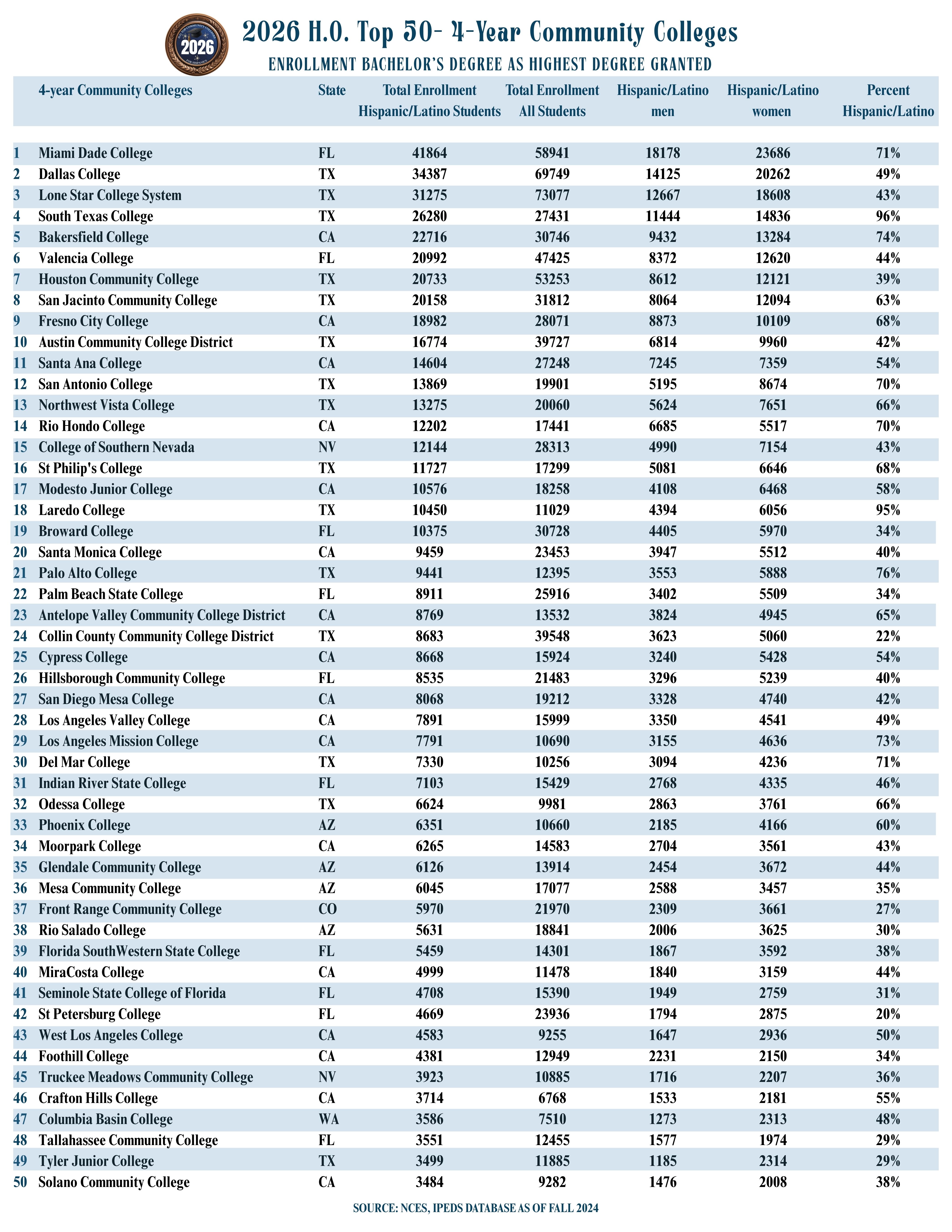
Four-year Community Colleges (with Bachelor’s Degrees as Highest Degrees Granted)
- In Fall 2024, all top 50 four-year community colleges enrolled a total of 557,600 Hispanic/Latino students, an increase of 99,371 students from Fall 2023. There has been accelerating growth in Hispanic/Latino enrolment at two-year community colleges over the past few years (with increases of 22,750 Hispanic/Latino students between Fall 2021 and Fall 2022, and of 38,476 between Fall 2022 and Fall 2023). Nonetheless, this huge increase of nearly 100,000 students between Fall 2023 and Fall 2024 is likely also the result of ten large and medium two-year community colleges transforming into four-year colleges and joining this list for the first time. In other words, as mentioned above, the loss in enrolment numbers for two-year colleges is the four-year community colleges’ gain.
- It follows that, according to the most recent data, more Hispanic/Latino students were enrolled at the top 50 four-year community colleges than were enrolled at the top 50 two-year colleges, highlighting the rapidly growing importance and presence of bachelor degree-granting community colleges.
- As with top 50 two-year institutions, all top 50 four-year community colleges are public. Similarly, the majority of top four-year community colleges are classified as “Large Mixed Associate” (24) and “Medium Mixed Associate” (11) institutions; the remaining ones are “Mixed Associate/Baccalaureate” (9) and “Professions-Focused Large/Medium Associate” (6) institutions.
- In contrast with the top 50 two-year colleges serving Hispanic/Latino students, which are mostly located in California, the top 50 four-year community colleges are more widely distributed across different states. Although the largest number are still found in California (17), these are closely followed by Texas (15) and Florida (10); the remaining top four-year community colleges are in Arizona (4), Nevada (2), Colorado and Washington (one in each).
- The top three of these four-year institutions – Miami Dade College, Dallas College, and Lone Star College System - enrolled more than 31,000 Hispanic/Latino students each (at least 10,000 more Hispanic/Latino students each than the top-ranking two-year community colleges, probably due to their larger overall size).
- A large proportion of Hispanic/Latino students were concentrated in relatively few four-year community colleges – enrollment at the top 10 institutions (254,161 Hispanic/Latino students) represents nearly half (46%) of total Hispanic/Latino enrolment at all 50 four-year community colleges on this list. This concentration of Hispanic/Latino students in a few institutions is thus even more pronounced among four-year community colleges than among two-year ones.
- The colleges with the highest percentage of Hispanics/Latinos as a proportion of total enrollment were South Texas College (96%), Laredo College (95%) and Palo Alto College (76%), all located in Texas.
Top 50 Community Colleges: Degrees Granted
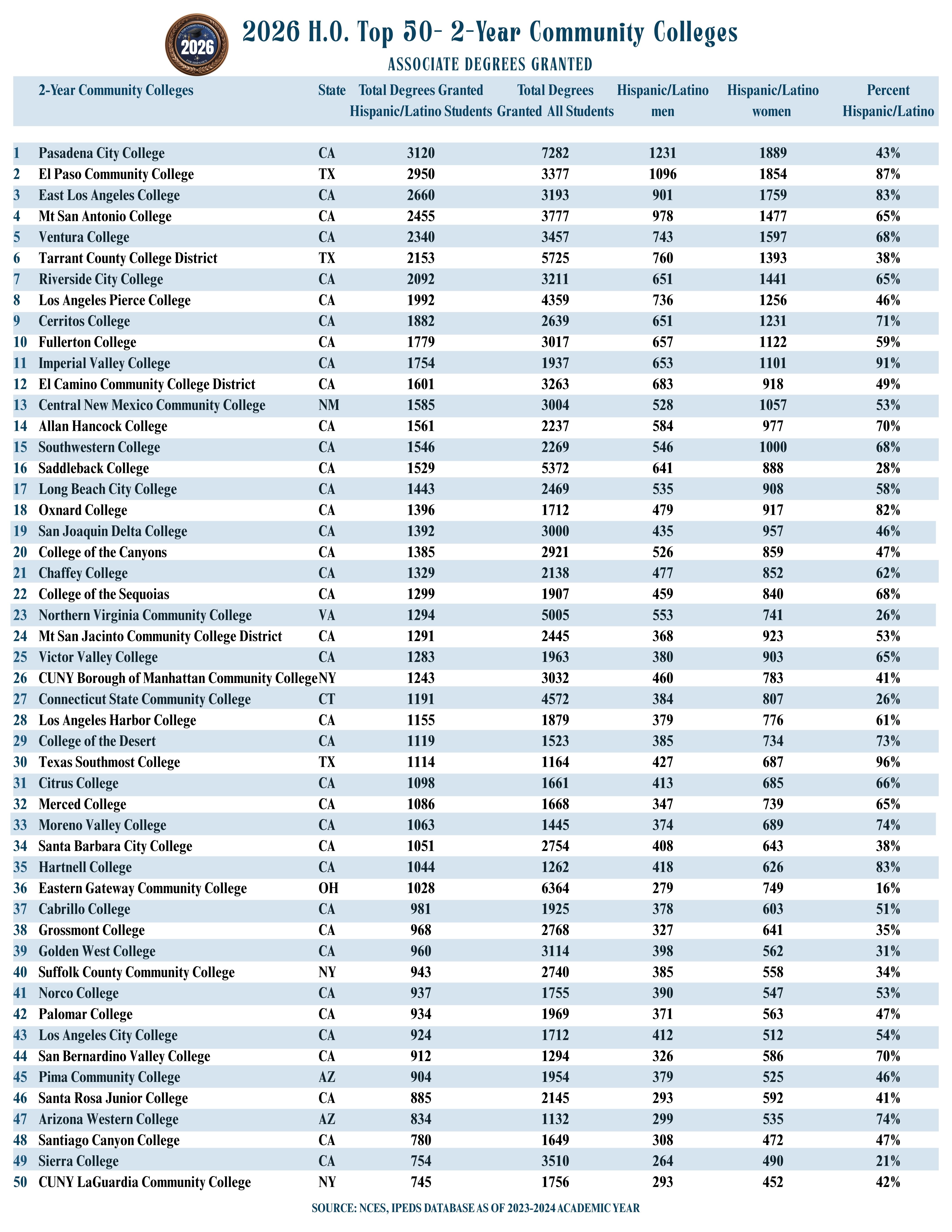
Two-year Community Colleges – Associate’s Degrees Granted
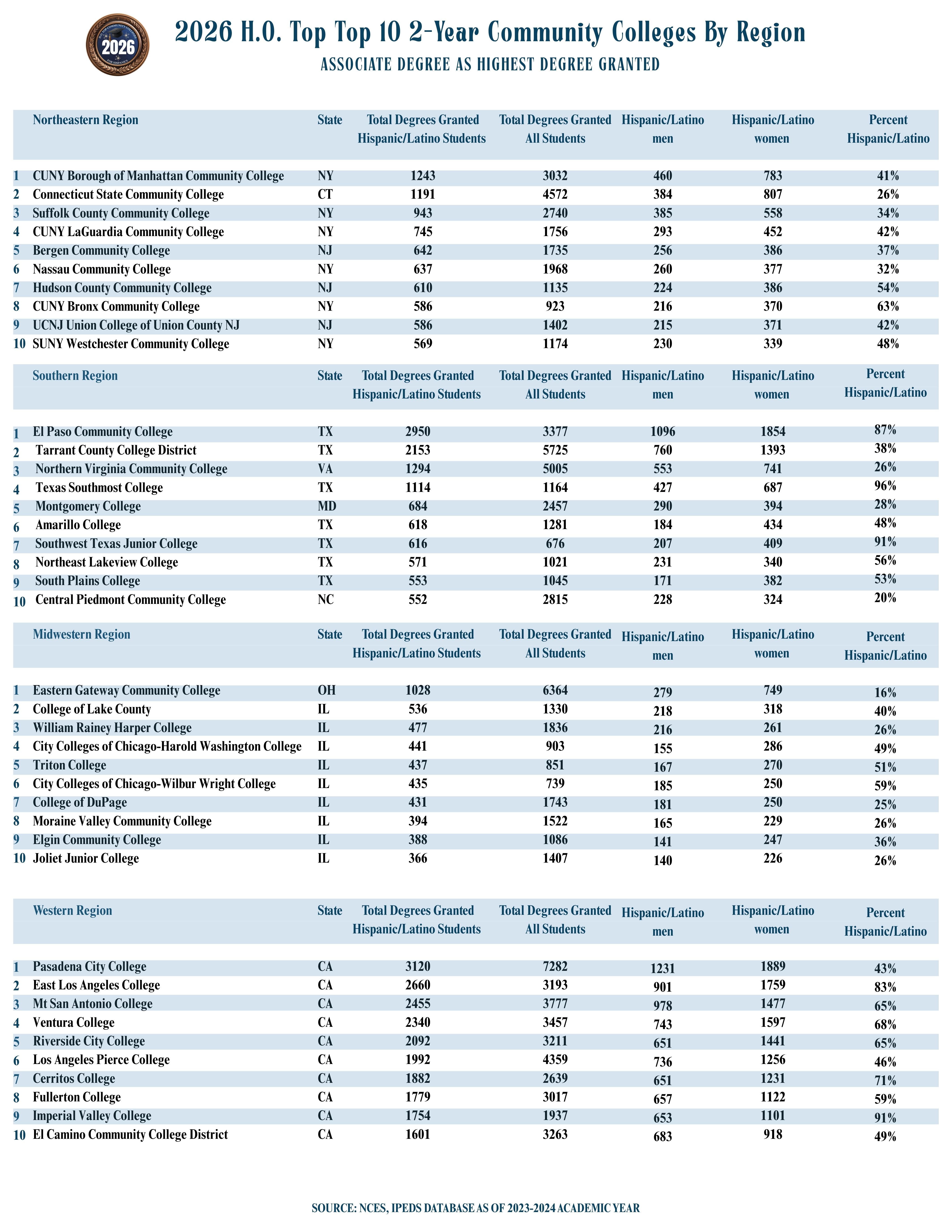
- In the 2023-24 academic year, the top 50 community colleges in terms of Associate’s degrees granted to Hispanic/Latino students conferred 69,764 of these degrees. This represents a slight increase from 2022-23, when 68,282 Associate’s degrees were granted at the total of these top institutions, However, it is still lower than the number of Associate’s degrees granted among these institutions (73,364) in the 2021-22 academic year.
- As would be expected, there is a large overlap between the institutions on the top 50 list of two-year colleges in terms of enrollment and those on the top 50 list of two-year colleges in terms of Associate’s degrees granted. Thus, the top 50 two-year community colleges on both lists were all public institutions, and they are mostly concentrated in California. The institutions on both lists are not identical, however, given that each college has different graduation rates; enrollment numbers and degrees granted also mark different parts of students’ college trajectories (the beginning and end points), so the data for both are naturally measured differently and provided at different times.
- The top ten community colleges on this list – headed by Pasadena City College, El Paso Community College and East Los Angeles College - together awarded 23,423 Associate’s degrees to Hispanic/Latino students, representing 34% of all Associate’s degrees awarded by the 50 schools on this list. This data mirrors the proportion of Hispanic/Latino students concentrated in the top ten two-year community colleges in the list of top institutions by enrollment.
- The colleges with the highest proportion of Associate’s degrees awarded to Hispanic/Latino students were Texas Southmost College (96%), Imperial Valley College (91%) and El Paso Community College (87%).
- Regionally, the data on Associate’s degrees granted by two-year institutions to Hispanic/Latino students reveals that El Paso Community College in Texas is ranked first in the South, the largest region in the country (comprised of 17 states). In the West, Pasadena City College in California is in first place, while in the Midwest Eastern Gateway Community College in Ohio ranks first, and in the Northeast, CUNY Borough of Manhattan Community College in New York awards the highest number of these degrees to Hispanic/Latino students.
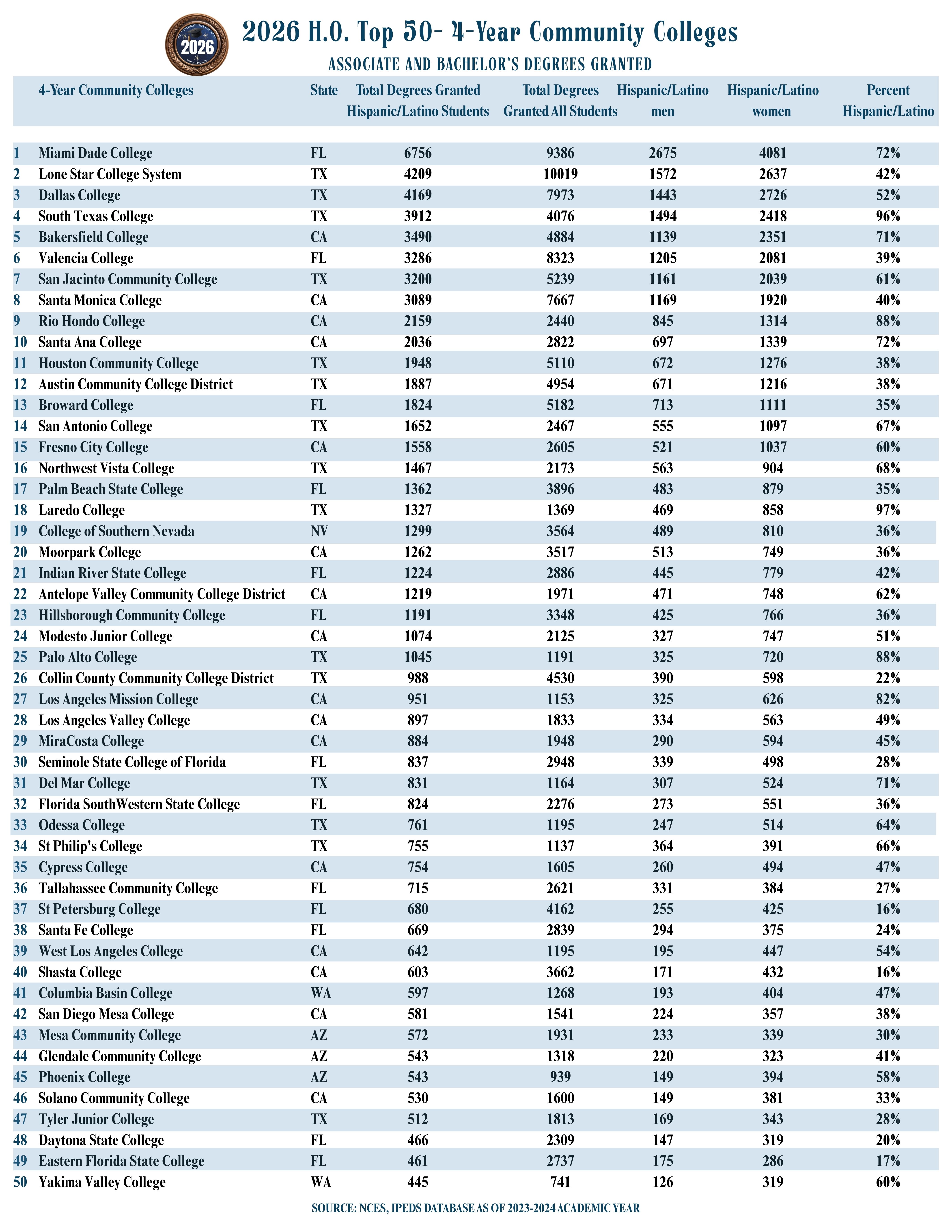
Four-year Community Colleges – Associate’s and Bachelor’s Degrees Granted
- In the 2023-24 academic year, a total of 74,686 Associate’s and Bachelor’s degrees were granted to Hispanic/Latino students by all top 50 four-year community colleges. This represents a substantial increase from the previous 2022-23 academic year, when a total of 64,419 of these two types of degrees were granted at the top four-year institutions.
- Among four-year community colleges, Miami Dade College ranks first in awarding the greatest number of Associate and Bachelor’s degrees to Hispanic/Latino students, with 6,756. The Lone Star College System, Dallas College, South Texas College and Bakersfield College round out the top five places on this list; each of these colleges awarded more than 3,400 of these degrees to Hispanic/Latino students.
- The 10 top-ranked four-year community colleges on this list conferred 36,306 Associate’s and Bachelor’s degrees to Hispanic/Latino students, representing nearly half (49%) of all Associate and Bachelor’s degrees conferred to these students at all top 50 four-year community colleges. As with enrollment, this indicates a high concentration of degrees awarded to Hispanic/Latino students at a relatively small number of four-year community colleges.
- The colleges with the highest proportion of Associate and Bachelor’s degrees awarded to Hispanic/Latino students were Laredo College (97%), South Texas College (96%), and Rio Hondo College (88%).